
Can you sing the Epodes?
A picture essay about annotations

Today’s post is a bit different from usual. This is a kind of picture essay on the annotations in a sixteenth century edition of Horace I bought recently.1 Looking at old annotations is one of the most fascinating and oddly intimate things you can do as a scholar, but even when scholarly publications draw significantly upon the analysis of annotation of this kind it is very rare to be able to include a lot of illustrations. This is for boring practical reasons — publishers of books and journals don’t want the expense of lots of high-quality images, and although in most cases libraries don’t mind you photographing books for your own research purposes, if you want to reproduce any images in a publication you often have to apply painstakingly for permission for each separate one, and there may be a fee for each reproduction. So authors and editors of articles that could really have used twenty images are very often forced to stick to just one or two.
In this case, though, I own this book so I can show you as many images of it as I like. I’m not going to make any detailed arguments about the annotations in this edition, which need further study, but the essay uses lavish illustration to try to give a sense of what annotations of this kind can tell a scholar not just about this particular book but also — cumulatively, by looking at many such examples — about how a certain text was being read. As I go along, I will note when the patterns here are, in my experience, pretty typical and where they are unusual.
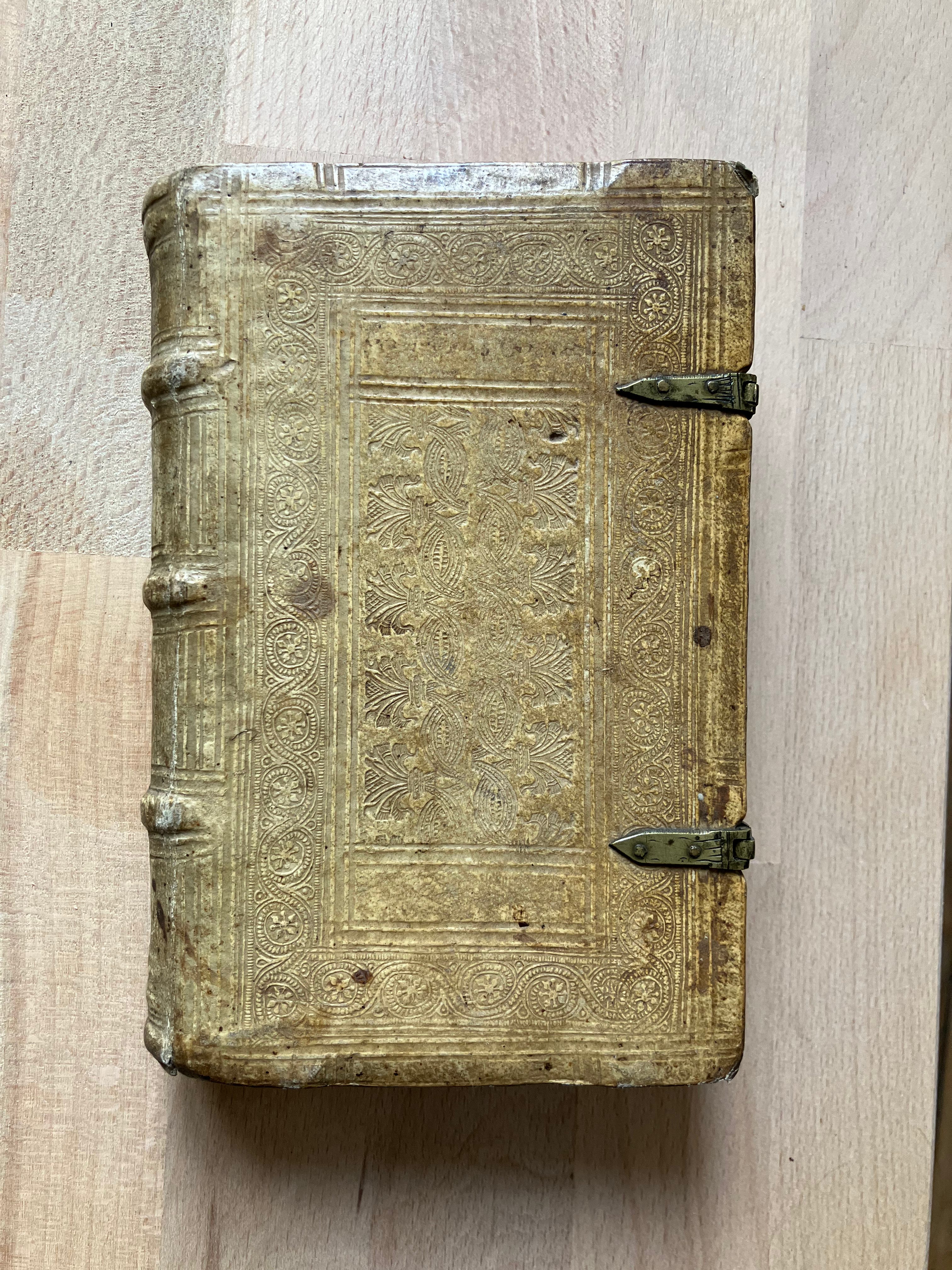
The book is a very nicely bound mid-sixteenth century edition of Horace, edited with introductions and a metrical appendix, printed in Freiburg in 1554. The binding is very good, still holding firm after several hundred years, and has a metal clasp which similarly still works. (These are actually very useful, as they help to stop the book spreading over time especially if at any point it gets slightly damp.)
There’s a very faded title on the spine, but also on the page edges as you can see below. (This says Quinti Horatij Flacci Poemata Omnia (‘All the poems of Quintus Horatius Flaccus’), followed by a little doodle of a flower.
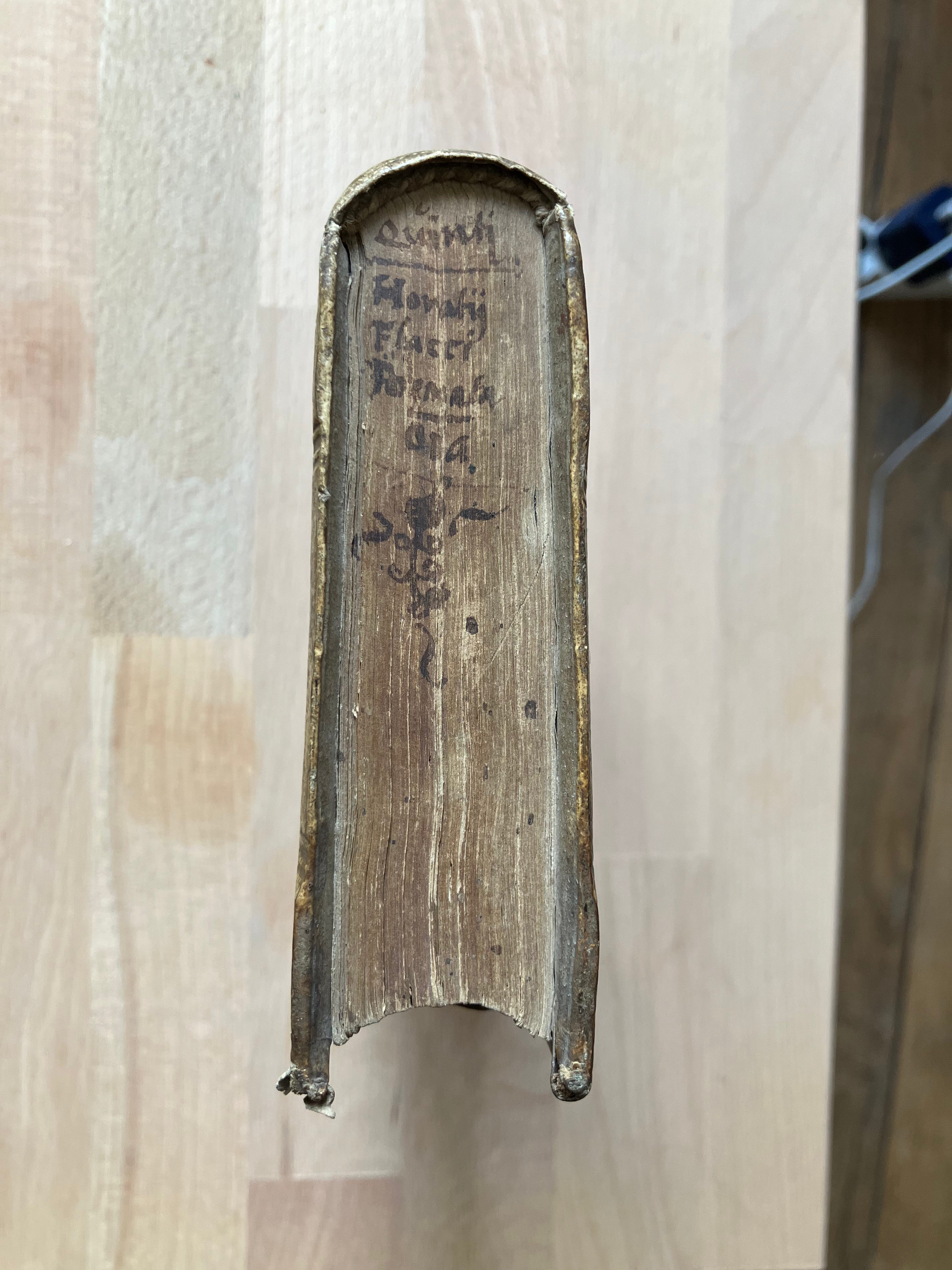
This implies that the book was at some point stored lengthways on a shelf, spine uppermost, rather than vertically. In this position, you couldn’t easily see any label on the spine, so a title written on the pages like this would tell you which book was which.
There are two owner’s marks on the title page, one of which appears to be dated 1659 (or 1654?) so about a century after the book was printed.
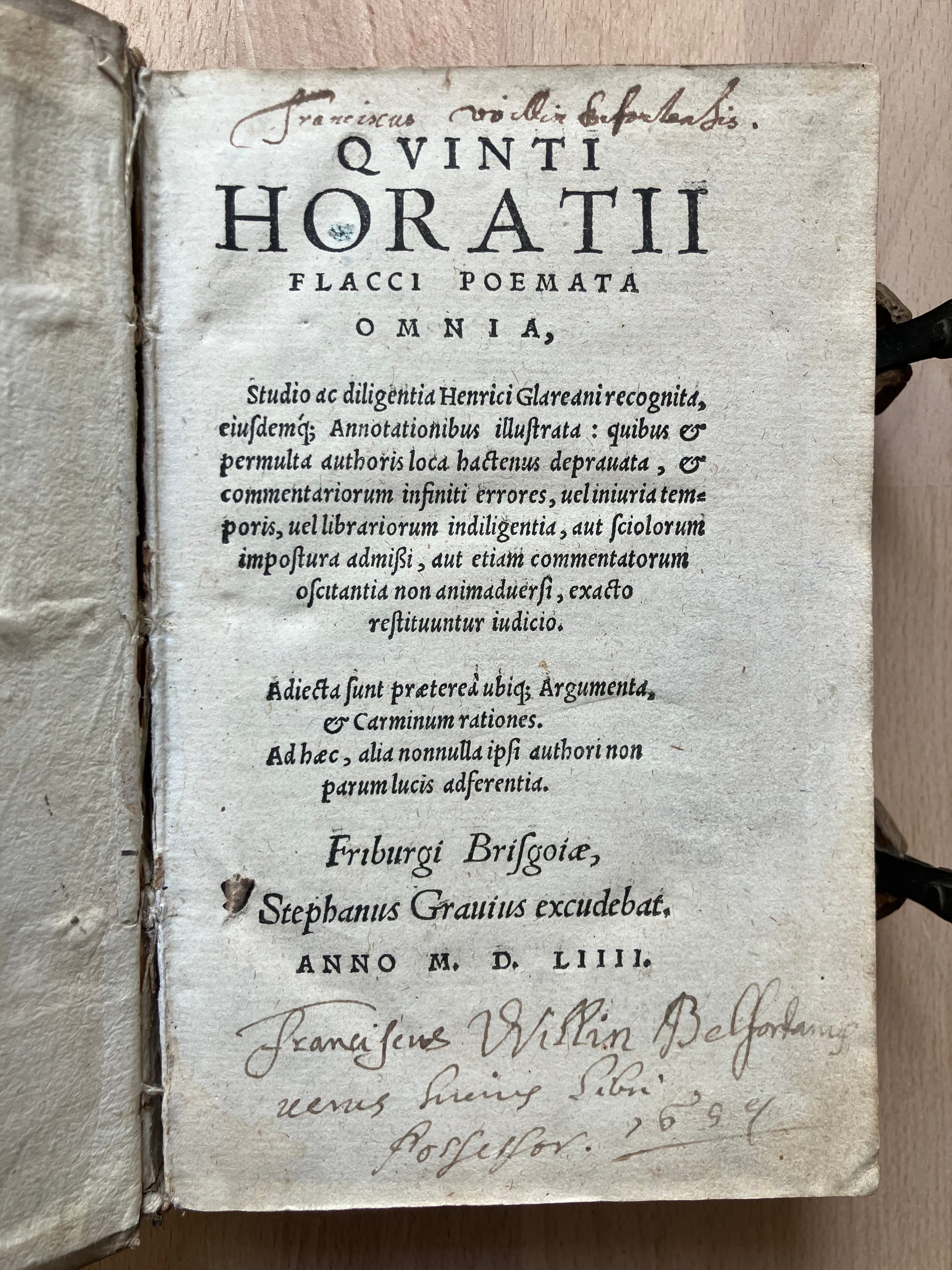
Both these inscriptions give the owner’s name as Francis Willin, adding ‘Befortensis’ at the top of the page and ‘Belfortanius’ at the bottom, i.e. ‘of Befort’ or Belfort. Belfort is obviously a place, and given the book was printed in Freiburg this is probably the Belfort now in eastern France, near the Swiss border — about 90km or 56 miles from Freiburg.
Books like this were frequently passed down and used by several generations, and it is not always the first owner who writes their name in. Here it is noticeable that the two signatures are in somewhat different hands — one more italic than the other — and it is possible that we have two Francis Willins in play, perhaps father and son; in which case the one who annotated the top of the title page was the elder. Although a signature doesn’t give you much to go on, most of the annotations in the body of the book appear to be in a similar hand to this top signature, but at this period it was common to be taught two scripts, one used mainly for the vernacular and one more for Latin, so the differences between the signatures does not necessarily mean that they are different people. The second inscription at the bottom of the page is followed by the phrase verus huius libri Possessor — ‘true owner of this book’, and the date. That assertive verus (‘true’) suggests to me that whoever wrote this wasn’t the first owner, and also that he was fairly young when put his name in the book.2
Horace was read extremely widely at school and I think it’s a fairly safe assumption that the annotations in this volume are wholly or mostly the work of someone of school age — either at a grammar school, or educated at home with a tutor. They might conceivably belong to an early stage of university study, especially as students often began at younger ages than today, but on the whole the kind of close reading of Horace we see here was a school activity, not a university one.
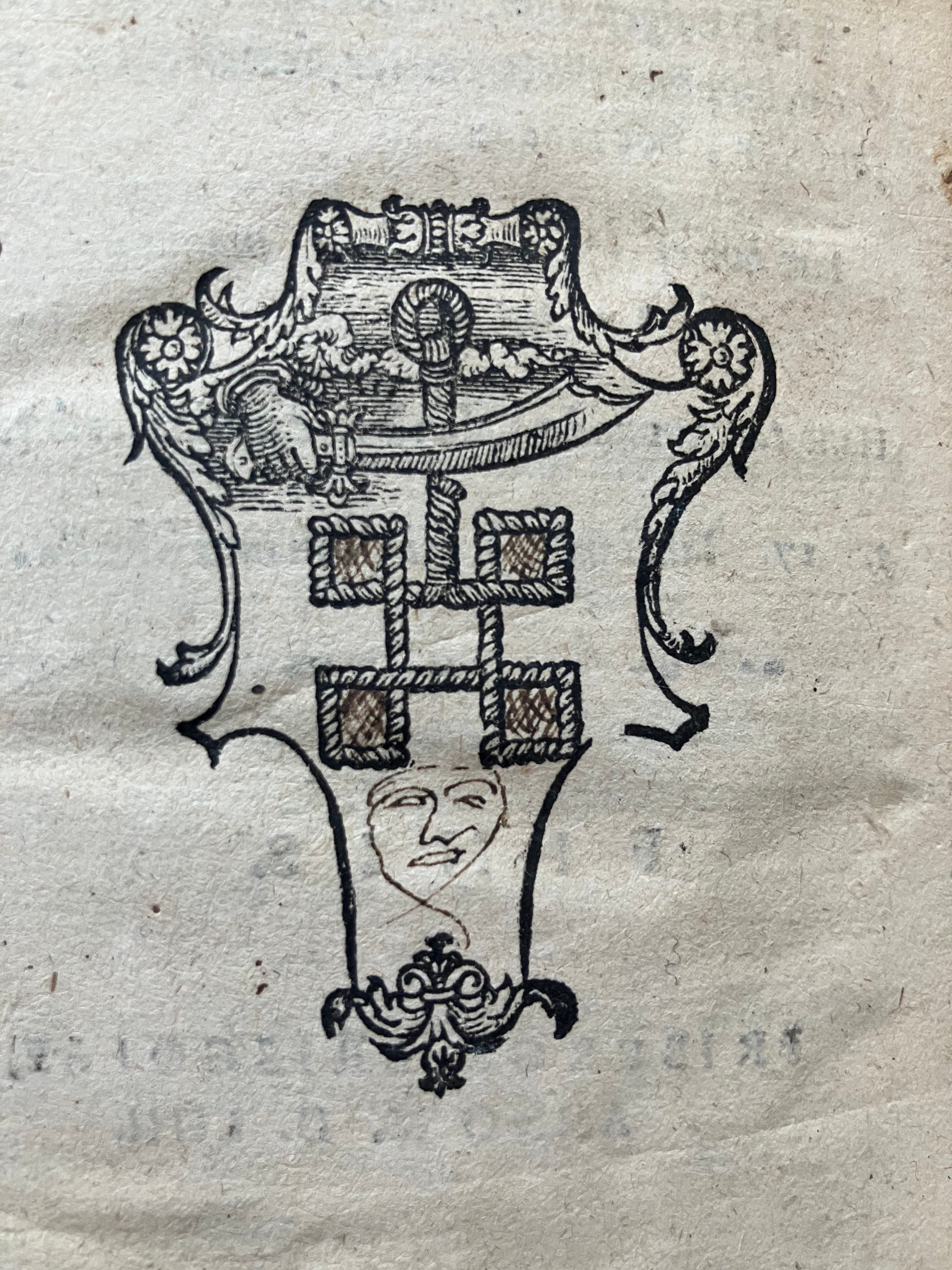
In some ways, the annotations are fairly sober. We don’t have any rude pictures, random doodles, sketches of the schoolmaster or ribald epigrams (in either Latin or the vernacular) as one often finds in schoolbooks, especially on the end papers. The only hint of student boredom is right at the back, where our annotator has coloured in the squares of the printer’s crest, and added a little face:
The annotations are mainly glosses and explanations and, as far as I can see, they are entirely in Latin. This is what you would expect: Latin was the medium of instruction in the early modern schoolroom and, at least until the late seventeenth century, you generally only find vernacular annotations or translations by the youngest pupils. Here for instance is the very lightly annotated first page of the Odes, showing the beginning of Odes 1.1:
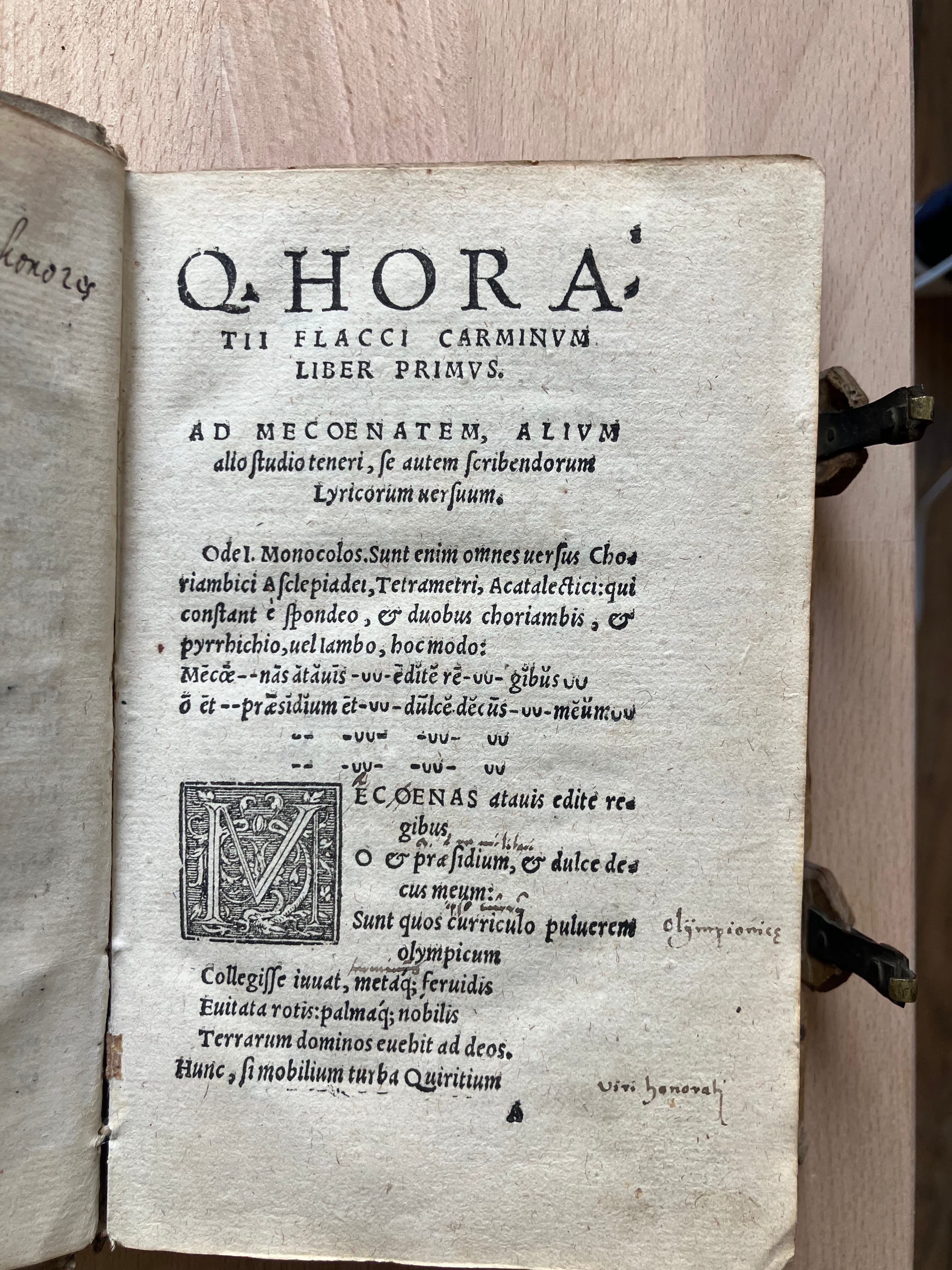
The interlinear glosses are extremely small and very hard to make out fully, but you might be able to recognise that Francis (let’s call him Francis) has glossed the ‘Olympic dust’, slightly redundantly, as referring to the Olympic games. The gloss viri honorati (‘of an honoured man’, i.e. ‘honoured by a public office’) is a bit more complicated. Here Francis is reminding himself that the hunc (‘this man’) at the beginning of the last line on the page is referring to a politician, who is happy if he succeeds in being elected. (This becomes clear as you read on over the page, but the gloss is a helpful reminder here.)
One other interesting element here is the correction of the first word of the poem, Mecoenas (in capitals in the centre of the page). Francis has deleted the first e, added an æ above the line to replace it and crossed out the ‘o’, converting Mecoenas into Maecenas — the form of the name of Horace’s patron with which most people are familiar today. Here I think we can hear the voice of his teacher, saying something like, “now boys, this is a good school edition with very helpful notes but the spelling of Maecenas’s name is outdated, so let’s start by correcting that in your copy”.
This page is only lightly annotated, while some others are much more so. For a denser but not excessive level of annotation, here’s an image of the latter part of Odes 1.2, just a few pages further on:
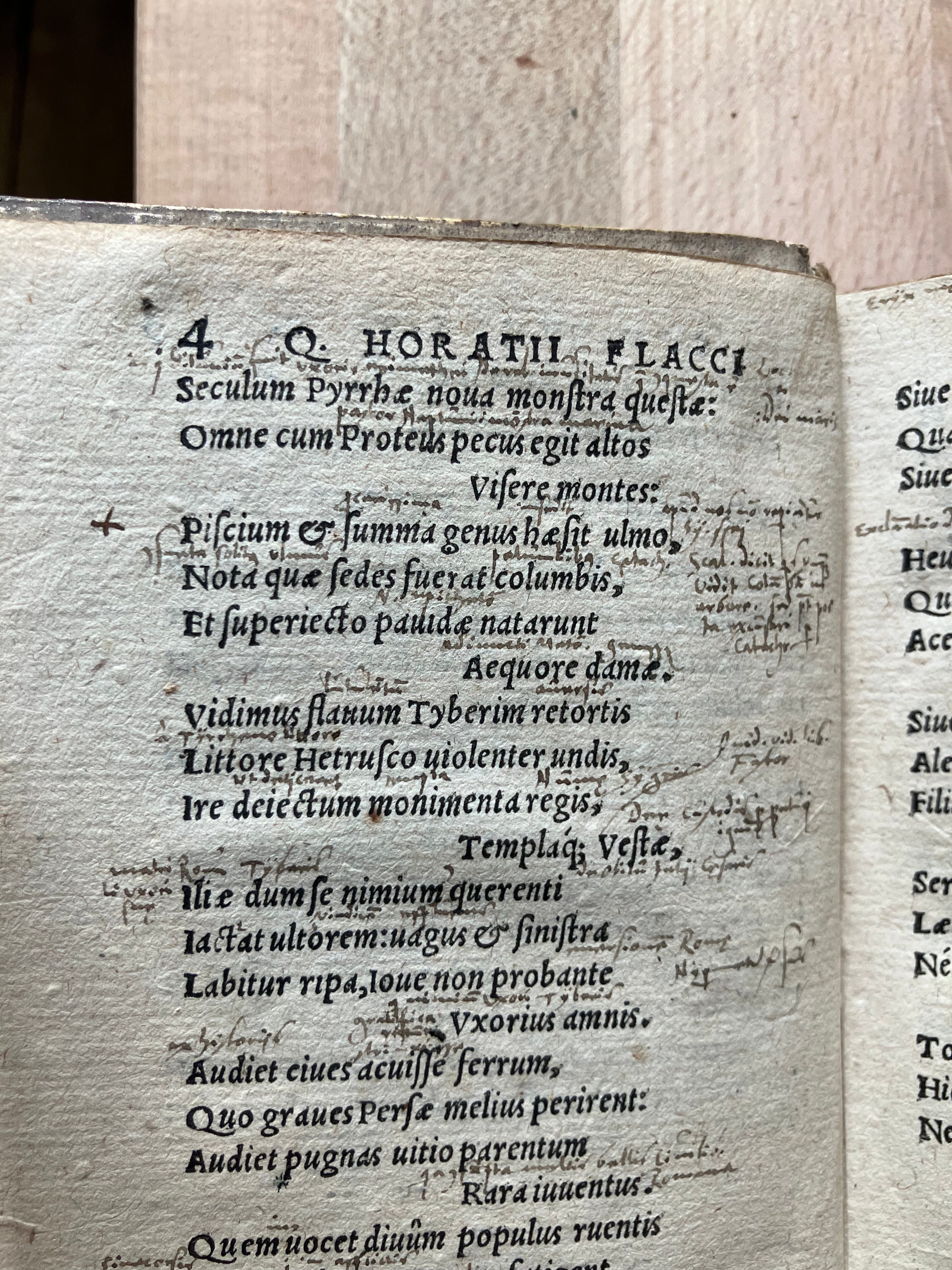
This is a mixture of glosses and a couple of cross references. The longest one, in the right hand margin, adds a reference to what Scaliger says. This is most likely a reference to Julius Caesar Scaliger’s Poetices libri septem (published posthumously in 1561), although it could also be referring to one of the works of his son, Joseph Justus Scaliger (1540-1609). If the exact date of these annotations was very important, this is the kind of reference that a scholar could try to cross-check.
So far these annotations are all on Book 1 of the Odes. Francis has read and annotated all or part of nine odes from this book: 1.1, 1.2, 1.4, 1.7, 1.8, 1.9, 1.10, 1.15 and 1.22. It is still quite common, when teaching Horace, to teach all or most of the first nine or ten poems of Book 1. This sequence sets up the moral, political and literary themes of Odes 1-3, its metrical variety (the first nine poems are all in different metres) introduces most of the metres repeated in the collection and it also contains a series of allusions to Horace’s main Greek models.
A modern teacher, though, would be unlikely to skip Odes 1.5, the lovely ode to the girl Pyrrha, which has been very often translated (including by Milton) and extremely widely imitated. Francis, however, does not just skip this poem, he deletes it:
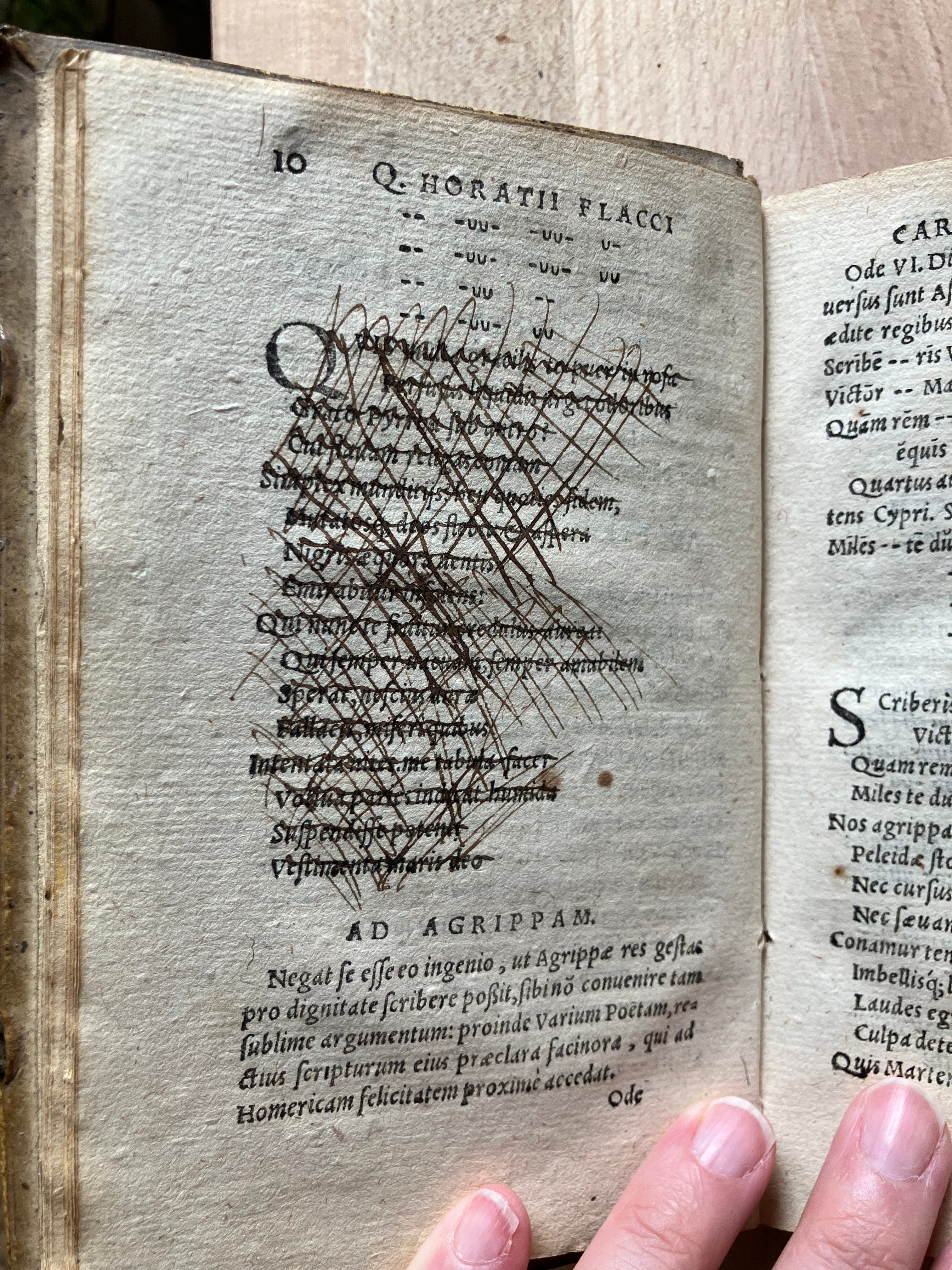
In fact, in this case, he has also heavily deleted the title and summary of the content on the previous page, as well as the final couplet of the preceding poem, Odes 1.4 (though he’s left the intervening metrical information intact, because all later poems in this metre will refer back to this explanation):
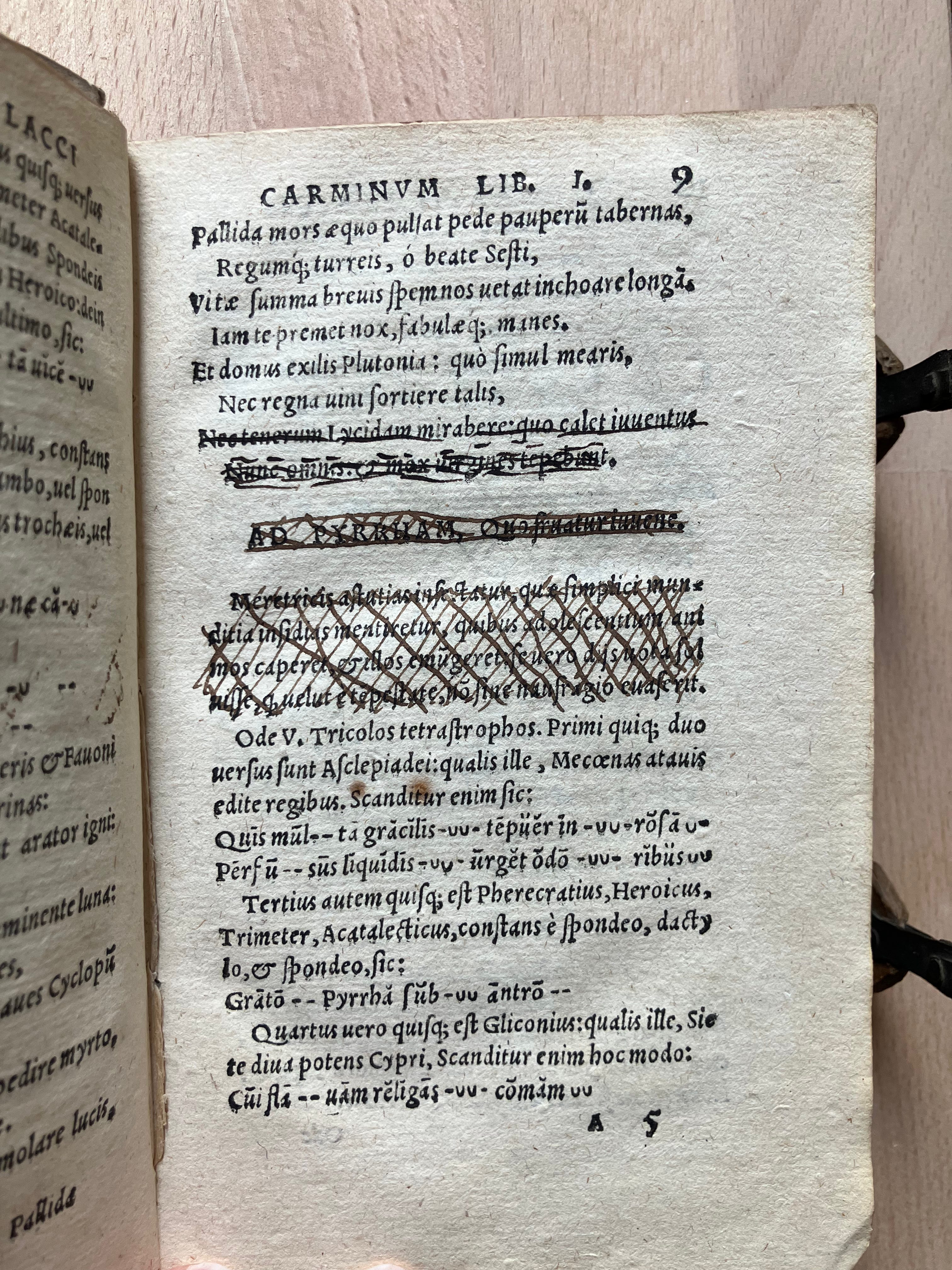
I think we can safely assume that he did this not on his own initiative, but under instruction. Also deleted are the end of Odes 1.6, some lines in 1.9, all of 1.13 and all of 1.23. Here you can see the deletion of the end of 1.6:
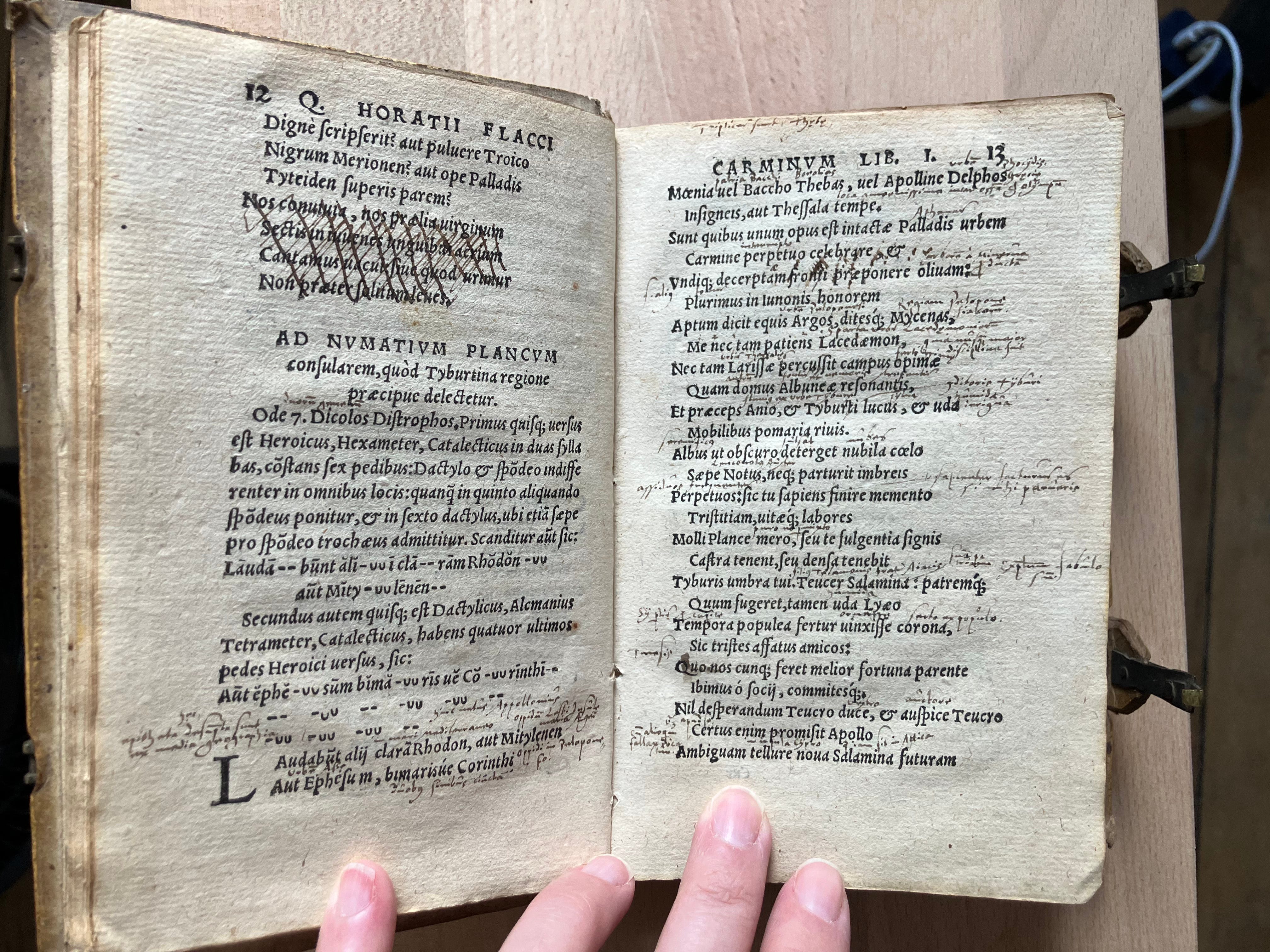
From a literary point of view, this is rather sad — these include some particularly lovely and well-known bits of Horace. But the common theme is obvious: these are the erotic parts. I think this striking pattern of deletion, which is found only in Book 1, further suggests that our annotator is a fairly young boy whose schoolmaster was sensitive to pedagogical concerns about inappropriate content.
After the fairly intensive study of Book 1, the rest of the Odes is much more lightly annotated. None at all in Odes 3 — a popular set text these days — and just two odes, 2.10 and 2.13, in the second book. Odes 2.10 is not a surprise — this poem about the ‘golden mean’ is probably the single most translated and imitated of Horatian odes in early modernity. There are three versions of it in Tottel’s miscellany alone. But this gives a sense of how Horatian lyric was valued for quite different things than it (generally) is today. The didactic and moralising elements of many of the odes were considered particularly important.
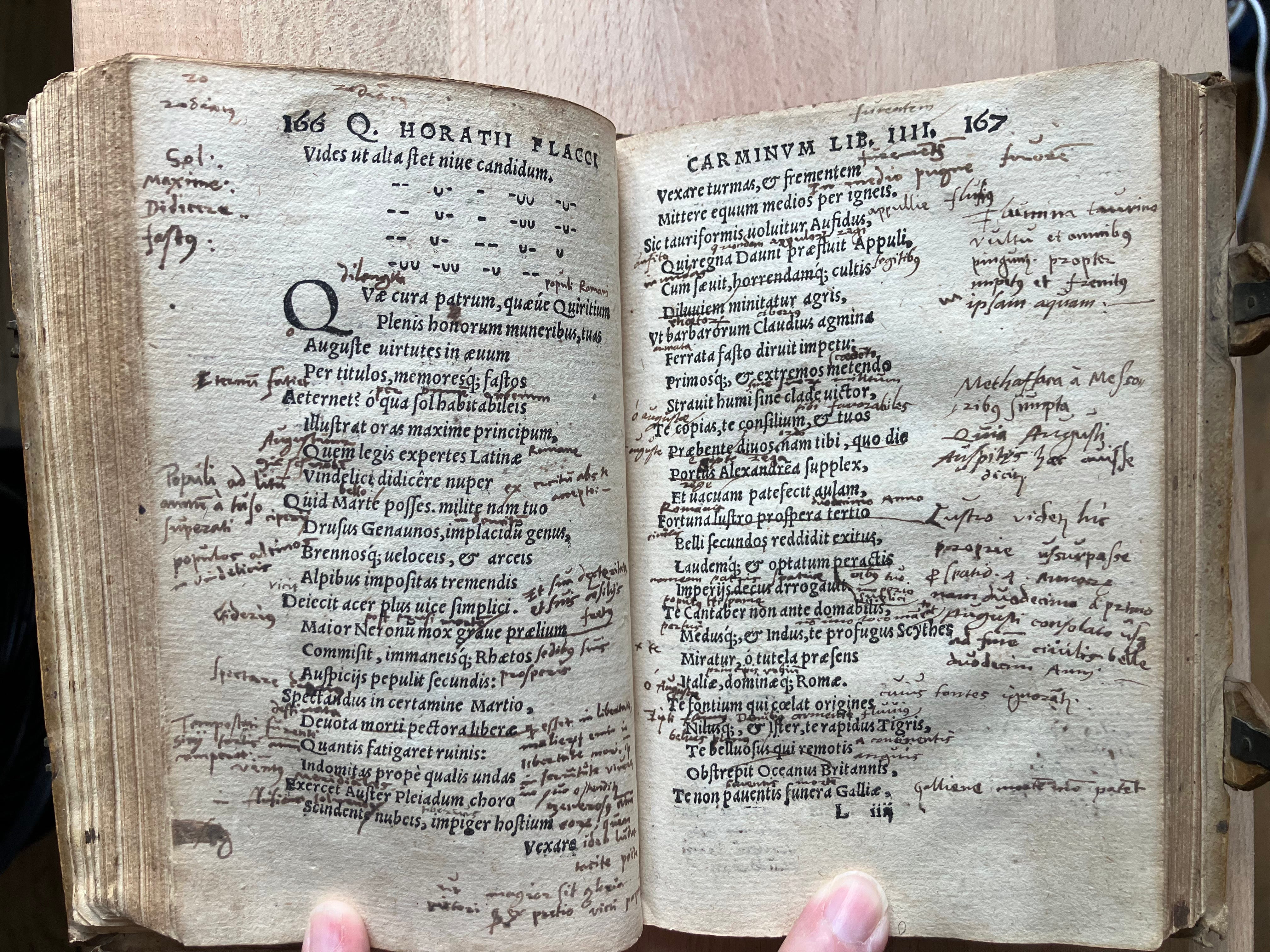
Today Odes 4, which was published in 13 BC ten years after the first three books, is much less often read and taught. Modern classicists are often embarrassed by its relatively straightforward panegyric of Augustus, especially towards the end of the book. But these poems were of great importance in earlier periods, when convincing panegyric of rulers remained a major part of what a poet was for. Evidently, Francis’s teacher thought so too as the final three odes of this book — 4.13, 4.14 and 4.15 — are particularly heavily annotated. Here you can see most of Odes 4.14, addressed directly to Augustus:
In the hexameter part of the book, we find only quite light annotation — one passage in the Ars poetica is underlined; a few phrases are underlined or glossed in Satires 1 and 2, and there are steady but mostly fairly light annotations throughout Epistles 1 (though not in Epistles 2). The first book of Epistles was also much imitated in early modernity — many of Ben Jonson’s odes, for example, include imitations of parts of this book.3
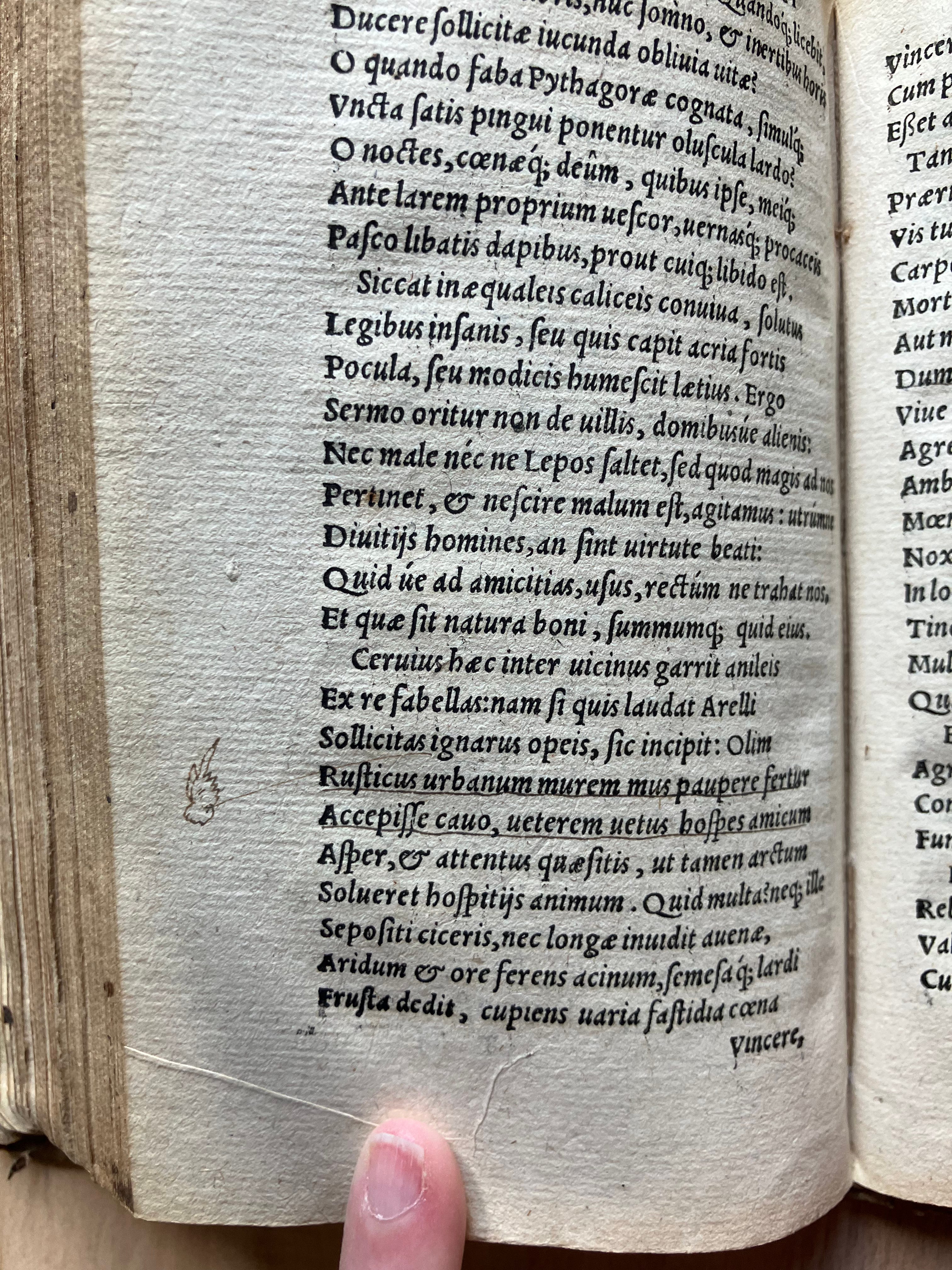
These annotations feel different from those in the Odes — they seem more like the product of active reading rather than detailed “working through” a text as you might at school. Here for instance a marginal pointing finger draws attention to the beginning of the famous passage about the town mouse and the country mouse (in Satires 2.6):
Although some parts of the Epistles have relatively dense annotation, here too the ‘rhythm’ of the notes feels different from those in the Odes. On the page below, for example, from the Epistles, we can notice that the handwriting of the annotations is quite even and regular compared to the heavy notes on Odes 4.14 pictured above. In the Odes notes, the handwriting often looks rushed, cramped and messy — like a pupil scrambling to keep up with his teacher’s comments and not quite sure when he starts how much he needs to fit in.
Here in the Epistles, our annotator looks more in control of the process. He’s less rushed, and he doesn’t run out of space because he knows at the start what he wants to say. This looks like someone making their own notes rather than taking dictation.
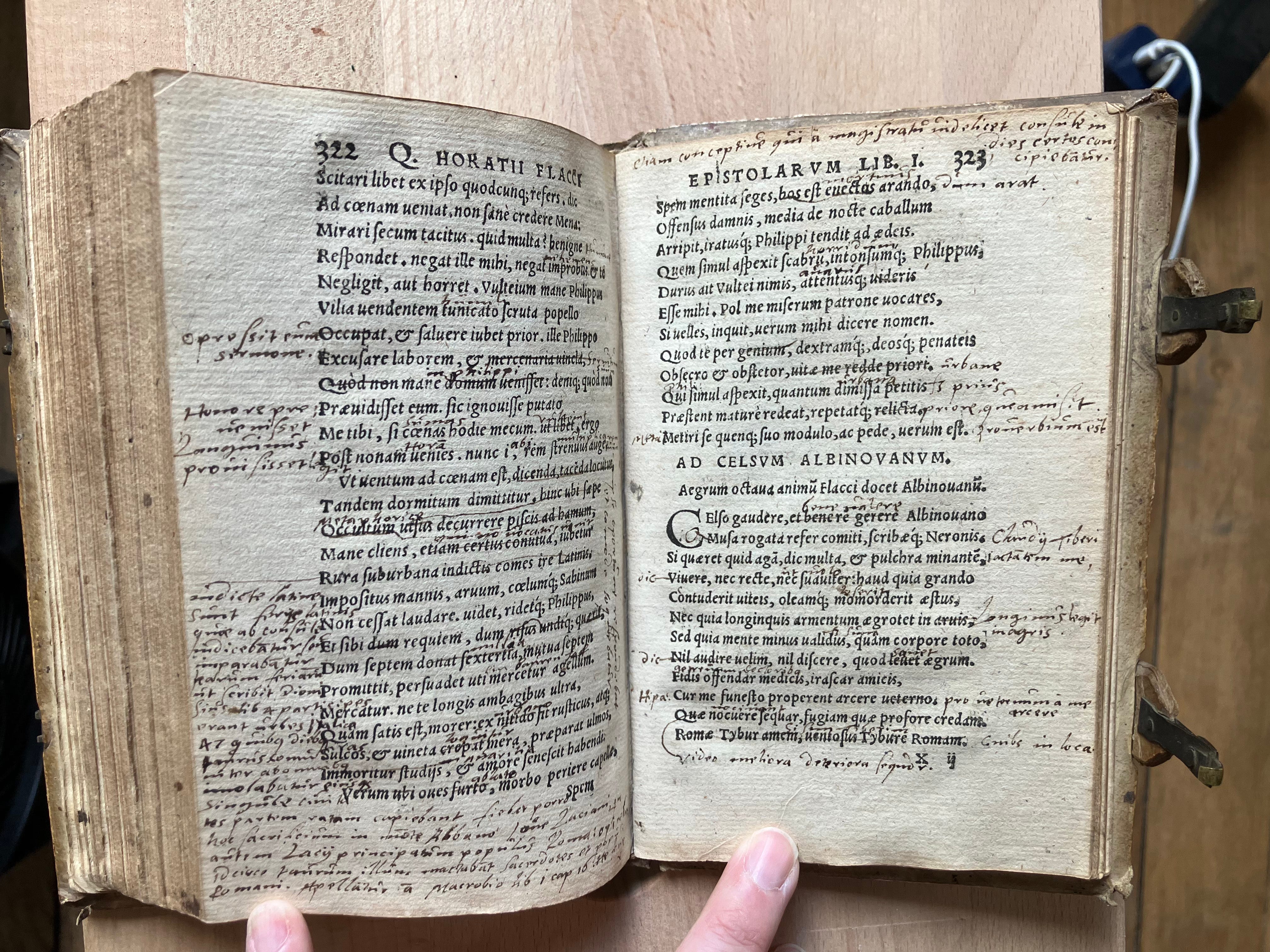
This might be because an older Francis is reading this material independently, or he might just have got much better at judging what his teacher was likely to say. But either way the impression we receive of the interaction between the pupil annotator, the text and the invisible teacher is quite different from in the lyric parts of the book. Spelling out this sort of point can seem laboured; but this is the kind of impression that an experienced scholar takes on board almost unconsciously. You get a “feel” for what you’re looking at.
The most fascinating part of this book, however, is the Epodes. The Epodes is probably the least fashionable part of Horace today: this mixed collection, with elements of elegiac and lyric verse as well as the iambic metres for which it is best known, belongs like Satires 1 and Virgil’s Eclogues to earliest stages of what would turn out to be Augustan literature. Iambic poetry in Greek is associated with invective, and there are elements of both satire and invective in the Epodes, as well as gentler kinds of humour and a couple of poems that could almost belong to the Odes. The Epodes were much more important in early modernity than they are today, and indeed iambic verse (rather than hexameter, like the Satires) was the usual mode for Latin verse satire and invective in the sixteenth and seventeenth centuries.
In fact, the first half of the Epodes are the most heavily annotated part of the entire volume. Surprisingly, the exceptionally obscene poems 8 and 12, though not annotated, are not deleted either — it seems hard to imagine objecting more to the odes to Chloe or Lydia than to these genuinely obscene poems. But perhaps it was precisely the eroticism of the odes that worried Francis’s teacher. Although Epodes 8 and 12 are sexually explicit, it would be hard to call them erotic. (If you are curious, you can read some fairly literal translations of these poems here, though caution is advised.)
Here is the annotation on the first part of Epodes 1 (addressed, like almost all of Horace’s opening poems, to Maecenas):
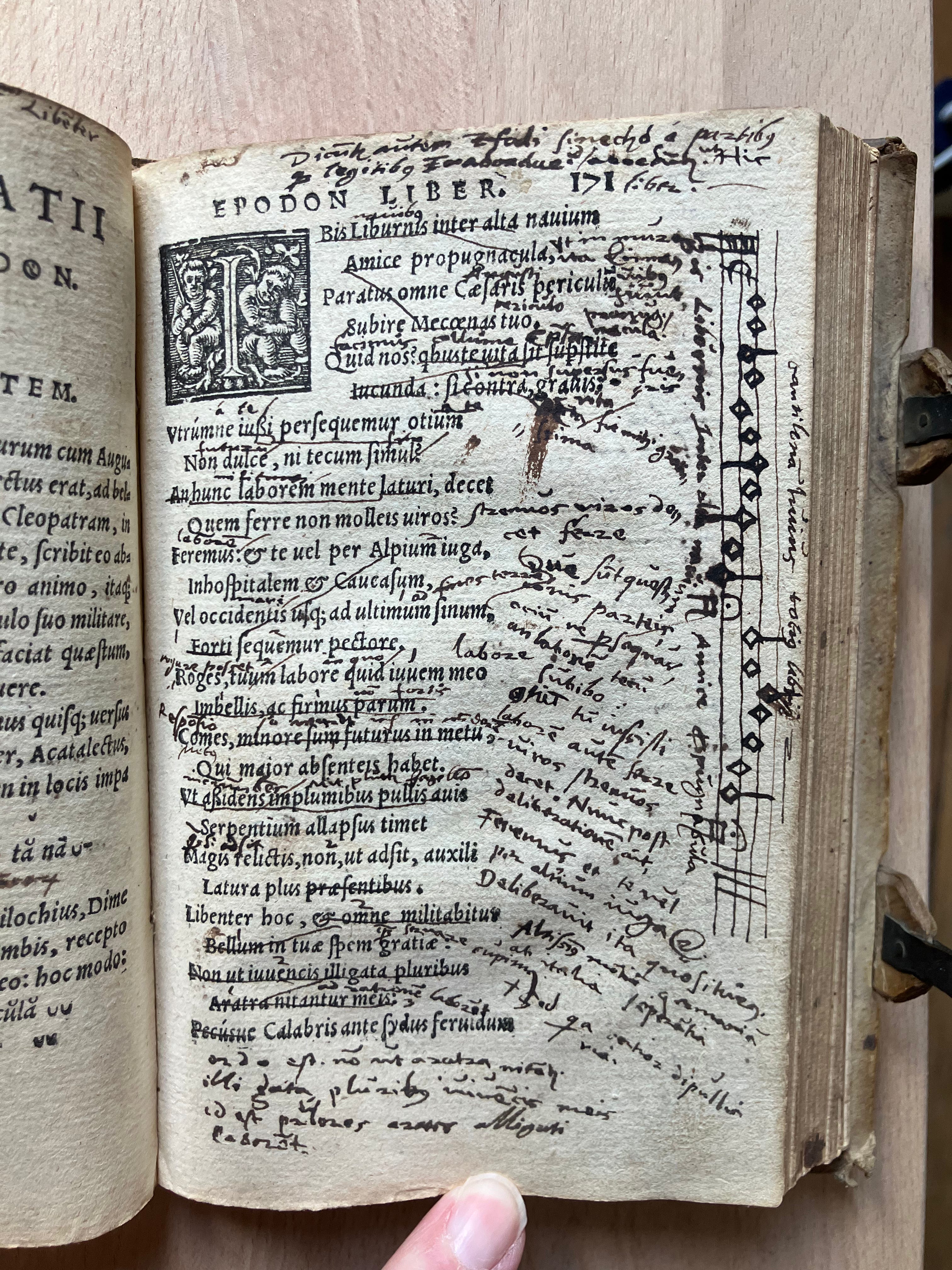
Of course the most striking thing here is the musical stave on the right hand side. Unfortunately, I know very little about early modern music and its notation so I can’t attempt to play the tune. But, fascinatingly, it does appear to be indicating a tune for the poem itself: the words beneath the stave are the first two lines of the poem.
Epodes 1 is written in iambic distichs: an iambic trimeter followed by an iambic dimeter. This couplet then repeats throughout, so a tune for the first two lines would be enough for the whole poem. The first ten epodes are all in this metre, so in theory the same tune could work for them all, but there is another piece of musical notation at the top of Epodes 3, as you can see below on the right hand side. This is shorter and it looks to me — though I am the opposite of an expert on this — as if it corresponds only to the trimeter, not to the trimeter and the dimeter.
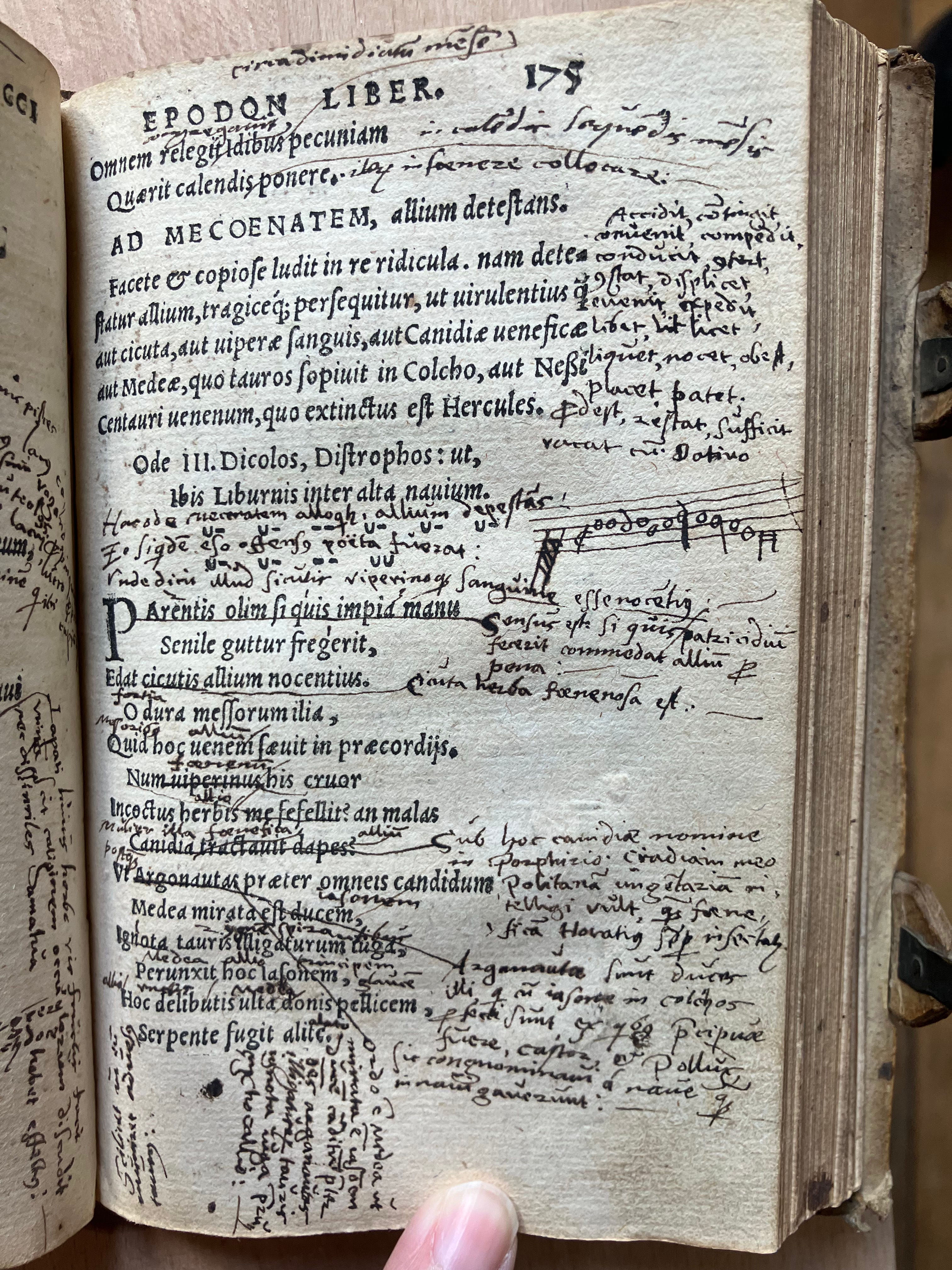
It is relatively common to find neumes (medieval musical notation) alongside the text of Horace in medieval manuscripts, especially in France and Germany, although my understanding is that these are usually odes rather than epodes.4 Although I have quite often seen scraps of music in early modern English books and manuscripts, I have never seen them attached to the text of Horace in this way, which perhaps suggests that the tradition of singing Horace’s Latin — especially at school — was more of a French and German tradition. It would be really fascinating to know whether the tunes noted here are recognisable, and whether they are anything like the ones recorded in medieval manuscripts. If any musicologists are reading, and have any thoughts, do please be in touch!
In any case, the mark-up of Epodes 1-5, 7 and 9 looks like it ‘belongs with’ the annotation of the odes. It is dense and quite messy and some of the glosses and other aids are fairly basic. In fact, I wonder whether Francis’s schoolteacher started with the Epodes rather than the odes — perhaps because the regular iambic distichs of the opening epodes defers the metrical complications of the Odes. Here in the particularly heavy mark-up of Epodes 2, for example (a much-imitated poem about the praise of the country life, translated by Ben Jonson among many others) if we zoom in to the top right hand corner of page 173 we can see that Francis has added small numbers above the words of the third line (2, 2, 3 and 1) and bracketed mitibus pomis together beneath the line. He’s also underlined the whole thing and linked it to a marginal note explaining that this is a poetical way of describing the autumn:
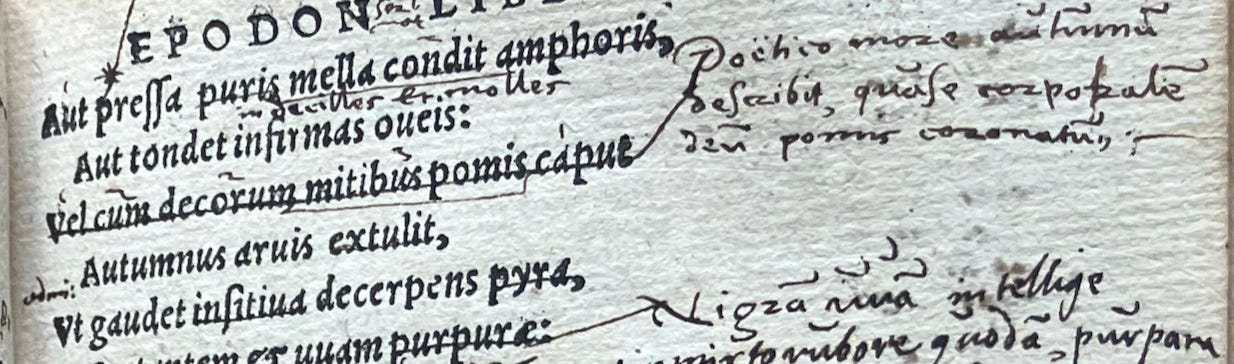
Any readers who did Latin at school probably recognise what those numbers are for — they are reminding Francis in which order to ‘take’ the elements of the sentence when translating into the vernacular: in this case, Autumnus (personified Autumn, in the next line) has raised up his head (caput), which is decorated or adorned (decorum) with ripe fruits (mitibus pomis) — as in Keats’ personified autumn with his ‘laden head’ and ‘mellow fruitfulness’. This is not really difficult Latin the reminder here suggests that these annotations belong to a fairly early stage of study. Perhaps Francis’s teacher likewise used songs or chants only at a relatively early stage?
I hope this ‘picture essay’ has offered a glimpse of the sorts of things we can learn from looking at early modern annotations. The censoring of erotic material is not in itself unusual, though more heavy-handed than is generally the case. On the other hand, the musical annotation is (in my experience) uncommon, and may reflect local pedagogical practice — a curious scholar might want to visit a large library in France or Germany to see if they can find similar examples. Such a study could tell us quite a lot about how Latin poetry in general and metre in particular was taught. Detailed study of all the annotations and cross-references would probably also give us a more precise sense of the books his schoolmaster was using — it’s quite likely that some or most of the marginal annotations are based on one or more available commentary. (This edition, as you can see, has a brief introduction to each poem, but no commentary in the book itself.)
In this particular case, the basic pattern of what Francis has read closely is fairly typical of the period — he (or his schoolmaster) has paid more attention to the Odes, Epodes and Epistles 1 than anything else, and within the Odes to Books 1 and the end of 4. Looking at many, many examples of this kind of annotation — alongside studying manuscript notes, translations and imitations — is how we can come to understand what a given author “stood for” at a certain period, and what it meant to have “read Horace” in early modernity. A modern classicist, for example, might tend to assume that an allusion to, say, Epodes 1, Epistles 1.18 or Odes 4.14 is rather obscure, and de facto unlikely in, for example, an author with no university education. Whereas the cumulative evidence of books of this kind would help us to appreciate that these are just the bits of Horace that, though unfashionable today, an author of this kind is quite likely to have read with attention.
We are away for August but as usual you will continue to receive regular (pre-scheduled!) posts from Horace & friends: some of these will be republished pieces that longer-term readers might recognise; some are new; and there will also be some new paid-only content, including a review of Emily Wilson’s new book of essays. (Where pieces were originally commissioned elsewhere, I republish on here for paid subscribers only in order to avoid undermining subscriptions for the commissioning publication.) During this period I am as usual always delighted to receive messages, though I can’t promise to reply until the start of September. I wish a very happy summer to all my readers, and excellent holidays if you are yet to take them.
I buy a lot of antiquarian Latin books, because in many cases that’s the only way to get hold of the editions I want; but I also collect editions of Horace in particular. This sounds like a very fancy and expensive hobby but you’d be surprised — see the first note in this recent post for just how cheaply you can buy early modern Latin.
Willin is quite an unusual name so it would probably be possible to identify the family with a bit of genealogical research; with luck, this might establish whether or not there were two successive Francis (or François or Franz) Willins.
On which see me, Jonson, Horace & the Classical Tradition (CUP, 2010).
There’s a book in German on this, which I haven’t read: S. Wälli, Melodien aus mittelalterlichen Horaz-Handschriften (Kassel, 2002). J. M. Ziolkowski has argued that many of these tunes in medieval manuscripts are more like chants — i.e. pedagogical mnemonics rather than evidence of a fully-fledged tradition of Horatian song (Nota Bene: Reading Classics and Writing Melodies in the Early Middle Ages, Turnhout, 2007).
Loved this. Musicologist here—but knowledge situated too early to answer the q about the music. I’d probably check it’s not a tune from the various 16thC Horace settings that were made for school purposes. I think the Giselbrecht article here https://doi.org/10.1111/rest.70054 might be useful.
What an extraordinary book, absolutely beautiful, and so is the pen and ink handwriting of the annotator! I loved seeing these photographs. A treasure and a family heirloom indeed.