
Larkin's odes
Lineage of joy into mortality hurled

There’s been a debate on social media this week about whether major works of literature or philosophy are best taught, in the first instance, with or without “secondary literature”. This was a pretty silly and rather graceless furore, in which most participants seemed to be speaking past one another. But I was struck that almost everyone meant by “secondary” reading, material about the texts; and almost everyone — even if they nodded occasionally to the value of looking at several different translations — treated the “text” as a transparently ‘primary’ source. But even if we set aside the gigantic elephant-in-the-room of translation, any classroom text has been edited.
I know this sounds rather pedantic — OK, if you’re a Shakespeare scholar it matters which text you read, but if you’re just getting started with Shakespeare it really doesn’t. Obviously there’s a good deal of truth to that. But all the same, editorial decisions can make a big difference to our sense of an author. Last week, Jem revisited Larkin’s ‘The Trees’ — a poem I love but about which he is interestingly equivocal; do read his piece about it. Every time Larkin comes up it strikes me that my sense of Larkin as a poet seems quite different from many other keen readers and this week I finally sat down and worked out why.
Like most British people, I imagine, I came across several individual Larkin poems quite early on because they are lots in anthologies and many are also supremely teachable. I learnt the whole of ‘Aubade’, Larkin’s last major poem, when I was about 13, and as I commented to Henry Oliver’s amusement in an interview with him last year, I always say this poem to myself at the dentist for some reason. (Try it! Nothing like the unvarnished fear of death to distract you from an unpleasant filling.) But I first read Larkin seriously when I was 15 or 16 when I bought Anthony Thwaite’s 1988 Faber edition of the Collected Poems. I read Thwaite’s edition very carefully and, at least the first time, systematically: I started at the beginning and read right through, annotating and underlining enthusiastically as I went along.
Larkin wrote a lot more poetry than he published and different editions of his work dealt with this in various ways. When Thwaite revised the Collected Poems for Faber in 2003 he placed Larkin’s four main published collections, which appeared at roughly ten-year intervals starting in 1945,1 at the front of the book, followed by a relatively modest selection of unpublished pieces. This seems a fair approach: it means the book is dominated by the poems Larkin himself wanted collected, in the sequences he devised for them. Archie Burnett’s much heftier 2012 Complete Poems also opens with the four famous collections, then prints other poems published by Larkin but never collected, and finally all the poems that survive in notebooks or letters but were never published. Burnett’s excellent edition also contains thorough notes on the dating and context of individual poems, drawing on Larkin’s notebooks and correspondence, and some critical annotations.
But Thwaite’s earlier 1988 edition, the one I learned Larkin from, does things differently. It begins in 1946, when Larkin was 24 — that is, after the 1945 publication of the first of his full collections, The North Ship, generally considered by critics to be some sort of apprentice work.2 He relegates all the poems up to 1945, published and unpublished alike and including the whole of The North Ship, to the back of the volume. But the main body of the book, beginning with poems written in 1946, prints all or most of the poems known to Thwaite in chronological order, regardless of whether they were included in any collection, or even published at all. This breaks up the famous collections — the familiar poems from The Less Deceived, for example, are interspersed with a whole range of poems either never published or published elsewhere, creating a rather different sense of the Larkin of the 50s. This procedure unsurprisingly met with a good deal of criticism, and you can see why Thwaite thought better of it.
But what it meant for me is that my sense of where Larkin “begins” is with a sequence of poems he wrote in the mid-late 1940s, most of which he never published.3 These poems are, certainly, less assured than the more famous bits of Larkin but many of them are nevertheless extraordinarily good. And even when they don’t really work, the poems of this period point clearly to two facets of his work which we tend not to associate with the mature Larkin: declarations of straightforward literary ambition and a palpable joy in the work.
Larkin’s extraordinary formal command becomes in the mature poet so absolutely assured that it is almost invisible. But in these poems you can still catch him experimenting, as in these sapphics from 1949, which are not systematically quantitative but certainly partially so.4 If you have any Latin lyric in your head, I think it’s impossible to read this poem and not feel sure that Larkin, too, had at some point read some lyric verse in Latin5:
Sinking like sediment through the day
To leave it clearer, onto the floor of the flask
(Vast summer vessel) settles a bitter carpet —
Horror of life.Huge awareness, elbowing vacancy,
Empty inside and out, replaces day.
(Like a fuse an impulse busily disintegrates
Right back to its root.)Out of the afternoon leans the indescribable woman:
’Embrace me, and I shall be beautiful’ -
’Be beautiful, and I will embrace you’ -
We argue for hours.
This is not a successful poem, and Larkin would probably have been horrified to see it published at all. It’s obviously an experiment: an experiment in metre, but also in metaphor, simile and the unexpected transition. That muddled simile of an impulse like a fuse disintegrating to its root must be remembering, and reversing, Dylan Thomas’ ‘The force that through the green fuse drives the flower’. (Thomas’s particular kind of romanticism was hugely fashionable in the 40s.) The poem is trying to do too much, and its dense abstraction doesn’t convince. Still: ‘out of the afternoon leans the indescribable woman’ is a very good line, even if it would be better without that unnecessary ‘indescribable’. Her role and position in the poem should itself tell us that, like Lycidas or Chloe in Horace, she cannot and need not be described.
You can hear in these lines the recurrent choriamb (— uu —) which is the ‘signature tune’ of sapphics and various related metres in Latin and Greek. Larkin no doubt read some Horace at school or university, as well as some of the English attempts at sapphics that crop up quite regularly in English poetry between the sixteenth and nineteenth centuries. He was perhaps influenced also by the choriambic music that recurs occasionally in both Hardy and Pound (as well as, for example, Bunting and Sisson, though both too late to be in play here). But the poem is obliquely Horatian in other ways too: many of Horace’s odes begin with a philosophical or political theme only to introduce an erotic object (whether boy or girl) at the very end. Sex in Horace is always both a distraction from, and a reminder of, the brevity of life. And Larkin here imitates too, actually quite unusually in English lyric, the signature shape of an Horatian ode, which typically ends somewhere quite different from where it began.6
But I’m particularly interested today in a long untitled poem, in thirteen eight-line stanzas, which he wrote in October 1946. I haven’t checked minutely, but I suspect it is probably his longest single poem. It begins:
Many famous feet have trod
Sublunary paths, and famous hands have weighed
The strength they have against the strength they need;
And famous lips interrogated God
Concerning franchise in eternity;
And in many differing times and places
Truth was attained (a moment’s harmony);
Yet endless mornings break on endless faces:Gold surf of the sun, each day
Exhausted through the world, gathers and whips
Irrevocably from eclipse;
The trodden way becomes the untrodden way,
We are born each morning, shelled upon
A sheet of light that paves
The palaces of sight, and brings again
The river running through the field of graves.
This is a rangy, energetic, and somewhat obscure poem which never quite manages to close upon its intended point. (About which Larkin was unusually precise, if colloquial, in a letter to James Sutton.7) But all the same, it’s often commandingly good. The unusual form — stanzas rhyming (or nearly rhyming) ABBACDCD — feels authoritative and bedded down: natural. And it contains some lines so lovely and — yes! in Larkin — joyful that I have known them ever since I first read them. Here is the end of the poem:
While years in wingspans go
Across and over our heads. Watch them:
They are flying east. They flying to the ebb
Of dark. They are making sorrow seem
A spider busy on a forgotten web.They are calling every fibre of the world
Into rejoicing, a mile-long silken cloth
Of wings moving lightwards out of death:
Lineage of joy into mortality hurled,
Endowing every actual bone
With motionless excitement. If quick feet
Must tread sublunary paths, attest this one:
Perpetual study to defeatEach slovenly grief; the patience to expose
Untrue desire; assurance that, in sum,
Nothing’s to reach, but something’s to become,
That must be pitched upon the luminous,
Denying rest. Joy has no cause:
Though cut to pieces with a knife,
Cannot keep silence. What else should magnetize
Our drudging, hypocritical, ecstatic life?
Formally, this is an ode in the high style: the grand philosophical ode, taken from Horace down to Malherbe, Jonson, Cowley, Keats and Wordsworth. It is notably ambitious and at the same time boldly traditional. Bold, I mean, because for all that he can’t quite spit it out, this is a poem about poetic immortality, the possibility that poetry — even this particular poem — might outlive us all.
I can’t think off-hand of a specific parallel for that eight-line rhyme scheme, but to me it sounds distantly French — Malherbe’s ode to Bellegarde, for example, has 10-line stanzas rhyming ABBACCDEDE and elsewhere he reverses the pattern and has stanzas rhyming ABABCCDEED. A grand ode in regular stanzas makes it more like Malherbe or Jonson — or indeed Keats — than (most of) Cowley or Wordsworth’s ‘Immortality Ode’. It’s also, of course, rather like that late great poem by Larkin himself, ‘Aubade’, which is in five 10-line stanzas rhyming ABABCCDEED.
There are other ways too in which ‘Many famous feet’ sounds like an early version of ‘Aubade’ (or, perhaps more properly, ‘Aubade’ a late version of the former). The earlier poem writes of the ‘instinct-to-turn-back / — Which, if there are sins, should be called a sin’ and how this leads to ‘great fear of death’, which is of course the theme of ‘Aubade’. The comparison only makes ‘Aubade’ even sadder, since it points up, as it were, all that has disappeared in the later poem: that causeless joy and the excited assurance that ‘in sum, / Nothing’s to reach, but something’s to become’.
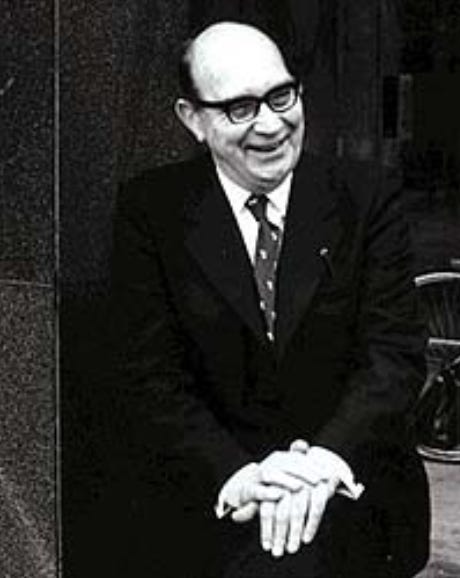
Larkin notoriously said that when he wrote a poem he never thought about other poems except ‘to make sure that one isn’t doing something that has been done before – writing a verse play about a young man whose father has died and whose mother has married his uncle, for instance’.8 This and similar comments poking fun at the self-consciously learned allusions of the modernists or insisting on his own lack of interest in the classical and scriptural ‘myth kitty’, combined with the extraordinarily smooth surface and consummate plain style of the mature Larkin, have quite often led critics and teachers to the conclusion that his poetry was not very much informed by any poets that came before, say, Yeats and Hardy.
This polite fiction is much harder to maintain in relation to the earlier poetry. ‘Many famous feet have trod’ is an ode in the grand style not only in its form but also in its allusions. In the first stanza, ‘The trodden way becomes the untrodden way’ describes the renewal of each day; but it’s also a neat version of a literary commonplace. Almost all the Latin poets claim to be setting out on an untrodden or unfrequented path — that is, an original one; though in most cases their originality consists in importing a form or theme from Greek.9 The motif has been imitated countless times in English poetry: Cowley, for instance, begins his Davideis by asking God to “Guide my bold steps with thine old trav'elling Flame, / In these untrodden paths to Sacred Fame.”
As he does throughout this long poem, Larkin describes one thing — here, the optimistic feeling that each day brings a fresh start — in a way that recalls, without quite spelling out, the grandest tropes of literary ambition, originality and immortality.10 Indeed, the opening of the poem is a version of a famous passage from Horace, Odes 4.9, a poem that Steiner in After Babel quite correctly identifies as ‘one of the templates for Western poetry and our image of the poet’. This poem, like Odes 3.30 (exegi monumentum, ‘I have built a monument more lasting than bronze’) are everywhere in European poetry over several centuries. It is, as it were, one of the Horatian ‘hit parade’. Odes 4.9 contains Horace’s most straightforward statement of the power of poetry:
Ne forte credas interitura, quae
longe sonantem natus ad Aufidum
non ante vulgatas per artis
verba loquor socianda chordis:[. . .]
vixere fortes ante Agamemnona
multi; sed omnes illacrimabiles
urgentur ignotique longa
nocte, carent quia vate sacro.
(Odes 4.9.1-4, 25-28)
The two full stanzas here mean:
Do not believe that they shall die, these words
which I, born by resounding Aufidus
with skill unseen before pronounce
to be set to music[. . .]
Before Agamemnon brave men lived —
many of them, but now they all lie dark
unwept in the long night because they lacked
a sacred poet.
In the stanzas I’ve skipped in this quotation, Horace gives examples — his poetry will endure like that of Homer, Pindar, Alcaeus, Anacreon and Sappho. Conversely, Helen was not the first married woman to be seduced, or the Homeric heroes the first men to fight bravely — they just seem like they are, because Homer wrote about them and so we still know their names.
In the opening stanzas of his ode, Larkin repeatedly invokes this idea of all the great men who have gone before without ever — quite — stating the corollary. His ‘famous’ men remain general and unnamed although we know they cared about their ‘franchise in eternity’. Larkin can’t quite bring himself to come out and say that he, like Horace, thinks he belongs to that small group of poets with the power to immortalise. But he allows the very form of the poem and its literary texture to make the argument for him.
The second part of the Latin quotation given above continues with a much-quoted epigrammatic sentence — paulum sepultae distat inertiae / celata virtus (29-30) — which is difficult to translate literally, as it is rather compressed and multivalent. It means something like ‘Courage (or virtue, or excellence) concealed is not far removed from buried idleness (or uselessness, or lack of skill).’ One recent translation has: ‘In the tomb, courage differs little from disgrace.’ Or, as Larkin puts it in ‘Aubade’: ‘Being brave, / Lets no-one off the grave. / Death is no better whined at [inertia] than withstood [virtus].’
That’s a very neat one-remove translation of Horace’s famous aphorism. But it is also, as it were, a misquotation. The point of the statement in Horace is the rider that Larkin’s late poem audibly does not include: being brave lets no-one off the grave unless you have a poet to tell of your courage. Perhaps by the end of his life Larkin had genuinely lost faith in that. Or perhaps the extraordinary power of ‘Aubade’ lies to quite a large extent in the way the poem itself declares blazingly and unforgettably what the speaker of the poem thinks he no longer believes. Many men before have woken at four in the morning terrified at the thought of dying, but the one we remember and recite to ourselves during unpleasant medical procedures is Larkin.11
I am not suggesting that Larkin was a secret classicist or had an undeclared passion for Horace. I don’t doubt for a moment that he read Horace himself at some point — it would be very surprising if someone of his background and education had not; but the Horatian features in his early work are all based on elements that have been very widely imitated in English for hundreds of years — such as the sapphic stanza, the odes on spring and the most famous and frequently alluded-to declarations of poetic authority. When Larkin was at Oxford, the English literature course ended with the Romantics and he certainly knew his way around medieval and early modern poetry.
The point is not that Larkin was a secret lover of Horace but just that if “your” Larkin begins with the poems he wrote between 1946 and 1950 — including all those which, like ‘Many famous feet’, he never published — the scope and authority of his ambition, and the joy he at least sometimes took in it, is unmissable. He knew that he could and would write poems that would not be forgotten, and he was right. There they are: wings moving lightward out of death: / Lineage of joy into mortality hurled.
The North Ship (1945), The Less Deceived (1955), The Whitsun Weddings (1964) and High Windows (1974).
Actually I love lots of poems in The North Ship which is a very good book of poems by any standards and pretty astounding for someone in their early 20s. It is usually described as being heavily indebted to Yeats, perhaps because Larkin himself commented on this and on how difficult it is to get out from under the influence of Yeats’ particular music. There is plenty of Yeats in The North Ship but the best poems in it are much more like Housman than Yeats.
Though some of them were included in an unpublished collection called In the Grip of Light, which he put together in 1947.
By this I mean that Larkin in this poem is clearly attending to the length of syllables as well as to whether they are naturally stressed or unstressed.
He did Latin at school of course, though he joined the Latin stream slightly late and by all accounts wasn’t very good at it. He passed Latin in his School Certificate, but only just. Latin was still a general requirement for Oxford entrance (in any subject) in 1940.
I have written about this feature of Horatian lyric here. Surprisingly few of the English lyrics most often described as Horatian are Horatian in this sense, and indeed this is true also of the prodigiously enormous number of early modern Latin odes in Horatian metres. Larkin also wrote ‘spring’ poems throughout his life, several of which have links to the tradition of the Horatian spring poems, 1.4 and 4.7. ‘Thaw’, written in late 1946 or early 1947 has the wonderful (and very telling) opening line: ‘The immortal streams are on the move.’ In 1940, Larkin published in his school magazine a poem called ‘Spring Warning’ which is a rather fascinating and sophisticated version of Odes 1.4.
‘In the poem I tried to express something of an attitude . . . What I feel is that death can ballock life. It does. But life can ballock death by means of sex (creating new life) or (less certainly) art . . . the emotion of being ballocked by death personally is sorrow, and the emotion of ballocking death impersonally is joy.’ From Philip Larkin, The Complete Poems, ed. Archie Burnett, pp. 590-1.
The motif itself is derived from Callimachus. It is found in Lucretius, Horace, Virgil, Propertius, Ovid and others.
You could make a similar point about Wordsworth’s ‘She dwelt among the untrodden ways’.
I have to admit that I have also occasionally reminded the children that courage “means not scaring others”, a very helpful aphorism I find.
One place from which Larkin might have derived some of this, choriambs and other metrical experiments, is W.H. Auden, who he seems to have read very closely when he was young.
Thanks for this. I wouldn’t have got the Horace connection.
I too know the disquieting and sublime Aubade by heart, along with other Larkin poems. He is the most memorisable poet I know (though Fenton’s ‘God: A Poem’ is another mnemonic contender). Keats’ Nightingale is also good for whisking oneself altogether elsewhere, as are chunks of The Four Quartets.
I had a cataract op not long ago, and, high on fentanyl, recited This Be The Verse and the aforementioned Fenton poem to the captive audience, god help them.