
O gentle tile
On Horace, Odes 3.21

One morning last week I woke abruptly from a dream about Horace’s ode to a wine-jar, Odes 3.21, which begins o nata mecum consule Manlio (“o female-thing born with me when Manlius was consul, i.e. in 65 BC”). In the dream, the first line was the actual first line but the following three were some kind of made-up dream-Latin, though in alcaics of course, like the original.1
Horace’s odes are almost all addressed to people. There are very few to non-human entities: just this one, 1.32 (the poet addressing his own lyre) and 3.13 (to the Bandusian spring). Odes 3.21 is accordingly quite often treated as a kind of comedy-ode or even a send-up of one, and this isn’t wrong, exactly: it obviously is meant to be humourous and perhaps quite affectionate. But thinking of it as a joke is not a very good guide to the experience of the poem either, because as so often in Horatian lyric, the poem ends up somewhere very different from where it started. If it begins as a kind of send-up of a hymn and a joke about Horace’s tendency to write poems about boozy parties, it ends as an actual hymn, with one of the most mysteriously beautiful closing lines in all of Horace.
In Latin, the opening of the poem teases us by delaying the subject until the final line of the first stanza:
O nata mecum consule Manlio
seu tu querelas sive geris iocos
seu rixam et insanos amores
seu facilem, pia testa, somnum
It’s very hard to recreate in English the effect in Latin here. But the first-time Latin reader will naturally assume — especially as almost every other Horatian ode is addressed to a person — that the o nata mecum of the opening line is a woman. (By beginning with an ‘O’ Horace also makes us thinks of hymns and therefore of goddesses.) A woman, indeed, of Horace’s own age (‘born with me’); perhaps even a twin sister. It’s hard to overstate how surprising this is for the experienced reader of Horace: almost all the women in Horatian lyric are younger, often implicitly slave girls, and treated as erotic objects.2
So we have an unnamed woman, of Horace’s age, who might bring in her train quarrels, or fun, or an outright fight, or the madness of love, or . . . . We think we know where we are here: aside from the age, a pretty typical erotic lyric scenario, in which the speaker’s success is uncertain, and there is probably at least one rival lover to contend with. Then we reach that final line: the madness of love seu facilem (‘or easy . . .’) — or ah! the possibility of something straightforward after all. Then pia, a word that brings us back finally to the vocative, which we’ve been waiting to return to ever since the opening words; pia here probably in the sense that a goddess can be pia, kindly to her devotees.3 And then, after all that, the noun turns out to be testa!
Testa is a very ordinary word in Latin for any piece of crockery or fired clay: it is derived from the verb torreo, ‘burnt’, as in ‘fired’. It can be a tile or a brick and is often a piece of broken crockery, a potsherd; it can also be a cooking pot, jug, urn or, as here, a wine jar. The deflationary effect is particularly sharp because beginning a poem with ‘O’ (indicating a formal address) but then having a long delay before you get to the vocative noun in question (here testa) is a feature associated with the grand style of hymns — as of course is the word pia.
So the woman, the erotic object approached with quasi-divine awe, bestower of pleasure and drama and pain by turns, turns out to be a jar of wine — equally inclined to lead to fights and fun and sex and, eventually, facilem . . . somnum: alcohol makes it easy to fall asleep.
It is pretty impossible to keep all these elements — the female addressee, the suggestion of both divinity and eroticism, and the way in which all the elements in the middle of the stanza could be produced either by alcohol or a lover — in play in English while delaying the subject. Colin Syndenham does quite a good job of teasing us in his translation by translating ‘nata mecum’ as his ‘brother of my birth-year’, but at the expense (obviously) of all the erotic and quasi-divine connotations of a female addressee:
Brother of my birth-year, purveyor of
moroseness, ready wit, reckless fracas,
romantic escapades, untroubled
slumber, o my worshipful wine-jar,4
Anthony Hecht, sometimes a good translator, in this case makes a wordy mouthful out of Horace’s decorous grace. It’s worth remembering that none of Horace’s words are pretentious or unusual:
O mise-en-bouteille in the very year of my birth
And Manlius’ consulship, celestial spirits,
Instinct with ardors, slugfests, the sighs of lovers,
Hilarity and effortless sleep, whatever,
Campanian harvest, well-sealed special reserve
For some fine and festive holiday, descend
From your high cellarage, since my dear friend, Corvinus,
A connoisseur, has called for a more mature wine.5
Hecht’s poem is impressive in its way, and I am personally always quite fascinated by ‘translations’ that seem to be almost hostile to the original — arguing with or resisting it. But Hecht’s poem is worth quoting here mainly because it couldn’t be much farther from the effect of the Latin.6 (The ending is dreadful as well.)
At the end of second stanza (corresponding to lines 4-8 of Hecht’s translation above) we discover the other person involved in the poem — in some sense, we might feel, its real addressee, even though strictly speaking he is not addressed directly:
quocumque lectum nomine Massicum
servas, moveri digna bono die,
descende, Corvino iubente
promere languidiora vina.
Here is a literal translation:
Under whatever name you keep your choice Massic,
Fit as you are to be moved on an auspicious day,
Come down, now Corvinus is asking
For some mellower wines to be brought out.
It is Corvinus who has asked for the wine jar to be brought down (Corvino iubente, ‘at Corvinus’s command’): down, rather than up, because Roman wine was often stored in the attic rather than the cellar. Corvinus is M. Valerius Messalla Corvinus (more usually referred to as ‘Messalla’), described by Nisbet and Rudd in their commentary as “the most versatile aristocrat in Augustan Rome”, with military, political and literary accomplishments and offices.7 He had been a consul in 31 BC, and was the patron of Tibullus and Sulpicia. He was probably the same age as Horace (and the wine-jar): that is, in his early 30s when Odes 1-3 was published in 23 BC. Evidently, Messalla is preparing for some sort of event, a dinner party or symposium.
This stanza, too, continues to play with the language of cult and hymnody. The wine jar servat its choice Massic wine: preserving it, as wine-jars or bottles are designed to do; but also protecting a person or place, as a god may be asked to do. When Horace says quocumque nomine, ‘by whatever name’, he hints too at the way that Roman divinities could be addressed by various names and cult titles and hymns often begin with some self-consciousness about which one to choose. The wine is moveri digna bono die, ‘fit to be moved on the appropriate day’, i.e. a good wine for a celebration. But again, all these words could equally be applied to religious ceremony: sacred emblems are moveri, ‘brought out’ on a sacred day and bono die is used of religious festivals.
The poet asks the jar to descende, ‘come down’ to him. Wine ‘comes down’ because it was stored in the attic; but divine powers and agents of divinity ‘descend’ as well. In Odes 3.4 Horace uses the same word to invoke the Muse: Descende caelo et dic age tibia / regina longum Calliope melos (‘Come down from heaven, queen Calliope, and sing a long melody on the flute’). Milton combines this motif and the polite uncertainty over the best name to use (quocumque nomine) in his address to Urania:
Descend from Heav’n URANIA, by that name
If rightly thou art call’d, whose Voice divine
Following, above th’ OLYMPIAN Hill I soare,
Above the flight of PEGASEAN wing.
Once again, the diction of Horace’s second stanza all points one way — towards the invocation of a god — right up until the very final word (vina). Even promere, ‘to bring out’ in the last line could be applied to sacred emblems. For a rather similar effect, see Rabelais’ invocation to the wine bottle, La Dive Bouteille.
The middle three stanzas of the poem tell us more about Messalla (he is ‘soaked’ in philosophy, but still enjoys a drink) and the powers of wine to sharpen the dull, reveal secrets and cares, restore hope and spirit. This encomiastic listing of attributes and abilities also recalls the conventions of hymnody. You can read the whole poem and Conington’s (rather good) translation here.
The final stanza works a delicate miracle. It’s as if the poet begins by setting up a joke but ends up, almost despite himself, singing a real hymn. This final stanza is still addressed to the wine-jar:
te Liber et, si laeta aderit, Venus
segnesque nodum solvere Gratiae
vivaeque producent lucernae,
dum rediens fugat astra Phoebus.
Let’s start with Shepherd’s very straightforward translation:
Bacchus [Liber] and Venus, if it please
her to come, and the Graces, slow to break
their bond, and burning lamps attend you
till returning Phoebus puts the stars to flight.
One way of understanding this stanza is that it casts into hymn form a pragmatic hope for the imminent dinner party: that there’ll be plenty to drink (Bacchus), uninhibited conversation (Bacchus as Liber, god of free speech) and, perhaps, some sexual activity (Venus, if she’s in the mood); that there’ll be something of the beauty, joy, song and dance suggested by the Graces, who typically accompany divine feasts; and that the whole thing will last until dawn (Phoebus = the sun).
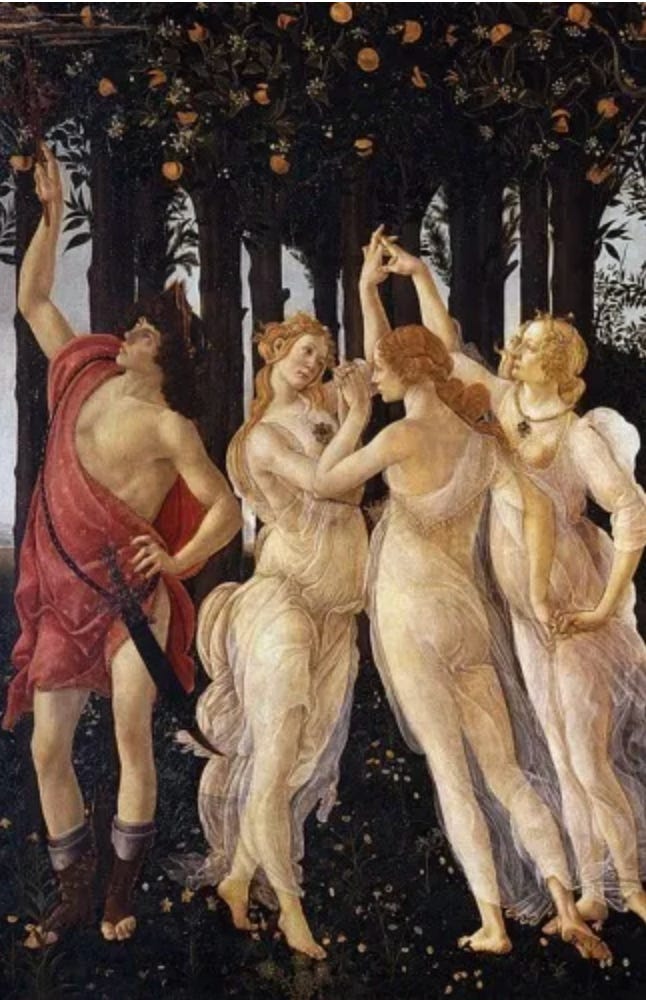
This is obviously in some sense what the lines mean. But it would, I think, be very wrong to feel that Horace’s invocation here of Bacchus, Venus, Apollo and the Graces is just a poetic convention, a way of varying the register, as religiously inert as Milton’s invocation of Urania.8 On the contrary, these final lines are a real hymn, intensely moving despite (or because of) its straightforward language. It is hard to pinpoint exactly what makes these lines so beautiful, but it must have something to do with the choice of details and the way in which Horace sounds at once both reverential and familiar. Venus only si laeta aderit, ‘if she comes in the right mood’ (suggesting an acquaintance with Venus in various moods). And amid the gods we have the ordinary details of the lamps still burning around the jar of wine (vivaeque . . . lucernae).
When the Graces appear, they dance naked and hand in hand.9 Horace’s description of them as segnes . . . nodum solvere seems to hint at both these things: in their modesty, they are slow to undo the knot of their dress or girdle and take off their clothes; equally, they are reluctant to unjoin their hands. (It is very difficult to find an English translation which suggests, as nodum solvere does, both of these possibilities.) This detail is intimate in the obvious way — it has an erotic connotation, it is sexy to imagine the Graces slipping off their clothes — but it is also intimate in a more profound way: the poet speaks as if he knows how the Graces behave because he has often been there when they come. And similarly, in the extraordinarily lovely final line of the poem, the party will carry on until Apollo comes back as he always does: dum rediens fugat astra Phoebus, ‘until returning Phoebus puts the stars to flight’.
How does Horace manage to strike this particular note of intimate reverence, of a kind of familiar awe? I suspect it is borrowed in part from Pindar, Olympian 14, one of the most detailed descriptions of the three Graces in Greek literature — and also one of the shortest Pindaric odes — which is both ravishingly lovely and also oddly down-to-earth. In Pindar, the three Graces are ‘stewards of all / works in heaven, placing their thrones / beside Pythian Apollo of the golden bow’. The word translated as stewards here, ταμίαι, is in origin a rather practical sort of word. A male ταμίας is the one who cuts and serves meat, the controller or director of affairs or steward of a household; it can be used of Zeus but also of the person who doles out the bread. The female term can mean a housewife. These Graces are not just allegories for beauty or music: they have concrete roles in the household of the gods.
In Pindar, the Graces place their seats beside Apollo ‘of the golden bow’. I think that Apollo — Apollo of the arrows, of the golden arrows of the sun’s beams — is present at the end of Horace’s poem. The last verb of the poem, fugat, is also a straightforward sort of word: it means puts to flight, makes flee — as a huntsman does the creatues of the hunt. The stars are fleeing before the golden arrows of the sun.
I think Horace learnt from Pindar here as he often did. But it would be foolish to pretend that the remarkable effect produced by the end of this superficially silly poem can be accounted for purely in terms of literary technique. I think that Horace at the end of 3.21 sounds like someone who loved the gods because he did.
‘Alcaics’ describes the metre of the poem, which is composed in four-line stanzas in which the first two lines of each stanza have the same metrical pattern, and the third and fourth lines have different ones: broadly speaking, the third line sounds ‘slower’ and the fourth line sounds ‘quicker’ than the first two, giving the stanzas a distinctive rhythmic pattern. The metre is borrowed from the Greek poet Alcaeus, hence the name. It is the most common metre in the Odes.
The only major exceptions are Cleopatra (born just four years before Horace, in 69 BC) and the aged Lydia. There is also the (unnamed and almost unstated) woman who is due to give birth in Odes 3.22, which I wrote about here. Outside the Odes, we find some examples of older/more powerful/more wicked women, especially in the form of the witch Canidia.
This less common attribution of pietas to a divinity rather than a person is found for examples in Virg. Aen. 2.536, 4.382 and 5.688f as well as Martial 2.3.9. Compare also the expression pie Jesu. It is from this kind of pietas that English ultimately derives pity.
Colin Syndenham, Horace. The Odes. Latin text, facing verse translation and notes (Duckworth, 2005). I reviewed this book for BMCR twenty years ago; that review is available here, and having just read it through, I still think it is fair. Readers with a particular interest in the recent translation of Horace’s odes might like to compare, say, Syndenham’s translation with those of Michie (old parallel-text Penguin of Horace’s Odes from the 60s), the quite starry but uneven cast assembled by J. D. McClatchy (Horace: The Odes. New Translations by Contemporary Poets) and the Horatian versions included in Chris Childers’ Penguin Book of Greek and Latin Lyric Verse (reviewed here).
As printed in McClatchy, Horace: The Odes (Princeton, 2002).
On Hecht’s poetry as a whole, including some comment on the role of translation in his work, see here.
His military exploits are celebrated in Catalepton 9, part of the Appendix Virgiliana (poems which have been attributed to Virgil but are no longer considered to be by him).
I don’t mean to imply that Milton’s invocation of Urania is ineffective, just that it is not genuinely devotional in the way that Horace’s is. Milton invokes Urania at the start of Book 7 of Paradise Lost for complex literary reasons. The invention of Urania as a Muse specifically for Christian epic is usually attributed to Du Bartas, glancing back also at Pontano’s Urania (c. 1480). But both Milton and Du Bartas borrowed her also from Palingenius’ Zodiacus Vitae. Milton invokes Urania to signal his debt to a specifically Protestant tradition of Christian epic. (Palingenius wrote before the Reformation, but was widely viewed as a kind of proto-Protestant.)
As in Odes 3.19: Gratia / nudis iuncta sororibus, Grace joined with her naked sisters.
I really like your essay on Odes 3.21. Well done!
Another facet of the poem that strikes me as characteristic of Horace is how he achieves such depth in what appears superficially quite simple and straightforward. (This is what makes the Odes so hard to teach to high school students and even undergraduates.) One technique I think I see here works quite like the rhetorical device known as *praeteritio*. The narrator tells us that neither X nor Y nor Z resists or is immune to the effects of wine. Not the philosophically minded, not champions of Roman tradition, not the woebegone precariat at Rome. That sounds wonderful until we remind ourselves that 95% of our lives is not lived under the influence. THAT rereading of this ode makes the last line pointed in a way that is pure Horace: the light of dawn returns the *pauper* to a life dominated by anxiety and fear.
Superb, thank you. That feels like a model response to a poem, and makes me, with little Latin, trust the poem is what you say it is,, something of a wonder.