
Love and compasses
Featuring Jonson, Bacon, John Borough, his wife and their twin sons

Earlier this week my middle son was surprised and even a bit indignant to discover that the words in English for le compas (which you use to draw a circle in maths) and la boussole (which you use to find which way is north) are the same. But aren’t they at least pronounced differently? he asked, crossly. I don’t use either kind of compass very often these days, though I do have to remember to buy the mathematical type depressingly often as for some reason it is the most frequently lost or broken element of the older boys’ fourniture scolaire — the baroquely complex list of school supplies that French schools send you in mid-summer and which you have to assemble (and label) in time for the new school year. This is a ritual element of French family life, part of the preparation for the grand rentrée at the start of September, and poorer families get a special grant to help with it.
We moved to France in the summer of 2021, when the older children were 6 and 8, so one of my first challenges was taking them to the vast “back-to-school” section of the nearest Monoprix, clutching two very long lists, in both of which I recognised, at best, about 50% of the vocabulary. The boys were already bilingual but only in the sense of chatting to their Dad and reading Tintin: they’d never been to school in France before and they didn’t have any more idea than I did of the difference between pochettes and classeurs, or paper that’s in feuilles simples rather than feuilles doubles, with grands or petits carreaux — though they were naturally very anxious not to turn up at a new school in a new country with all the wrong kit. As a result the whole thing was a bit stressful. Much as I love a good vocabulary challenge, I remember feeling literally dizzy in the aisles — though that might also have been because I was in fact already pregnant with the next one.
Le compas, though, was one word I did recognise, and because I read Jonson pretty much continuously for five years or so in my 20s, I can never think of a compass without remembering that for him it was the perfect emblem of a life well lived:
Stand forth my Object, then, you that have been
Ever at home; yet have all Countries seen:
And like a Compass, keeping one Foot still
Upon your Center, do your Circle fill
Of general Knowledge; watch’d Men, Manners too,
Heard what times past have said, seen what ours do:
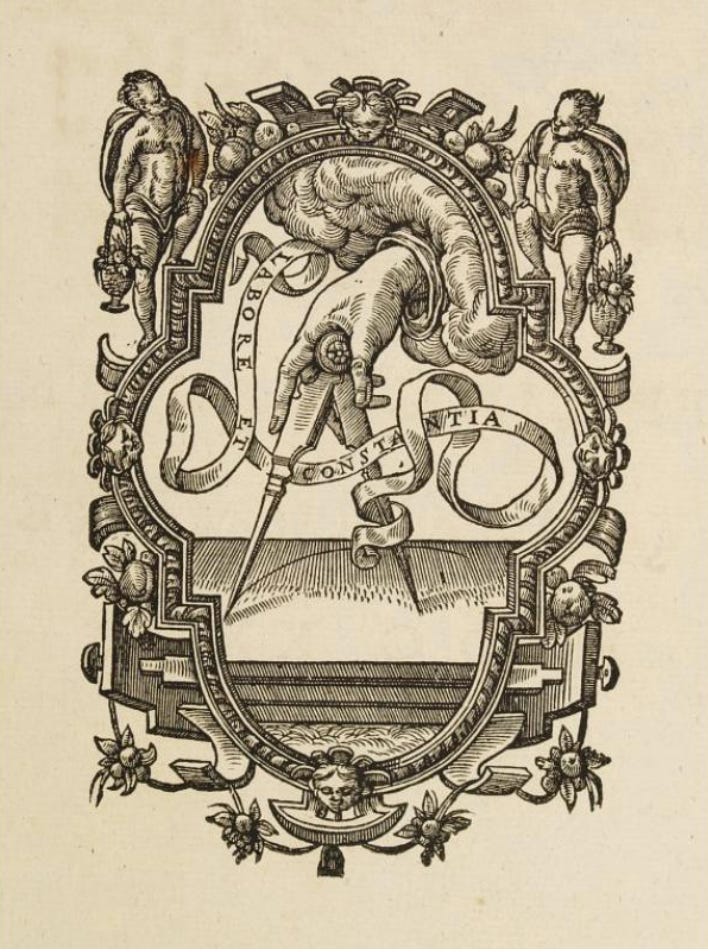
These lines are from his epistle to John Selden in Underwoods, and they draw upon a common Renaissance emblem of the compass as an image of labor et constantia — an ethically ideal combination of wide-ranging effort and psychological constancy.1 Jonson’s verse letters, by the way, are both a triumph and a lasting consolation — I wrote about why I love this aspect of Jonson so much in this piece last year.
Funnily enough, this week my middle son received a (navigational) compass as one of his birthday presents — hence the conversation about English terminology I started with — and I also had to buy yet another mathematical compass for my oldest son, who had lost his (yet again: older and wiser as I am, I only buy very cheap ones now). Thinking about these various compasses reminded me of this quite famous passage from Francis Bacon’s Novum Organum, where he credits the invention of the ship’s compass as one of the three great discoveries marking off (in his terms) modernity from antiquity:
Again, it is well to observe the force and virtue and consequences of discoveries, and these are to be seen nowhere more conspicuously than in those three which were unknown to the ancients, and of which the origin, though recent, is obscure and inglorious; namely, printing, gunpowder, and the magnet. For these three have changed the whole face and state of things throughout the world; the first in literature, the second in warfare, the third in navigation; whence have followed innumerable changes, insomuch that no empire, no sect, no star seems to have exerted greater power and influence in human affairs than these mechanical discoveries.
Bacon here calls a ship’s compass simply ‘a magnet’, and in fact the term ‘compass’ for a navigational compass is quite a late addition in English. Most of the other meanings of the noun, some of which are now obsolete — including ‘measure’, ‘ingenuity or design’, the circumference of a circle, a circular object, a curve, a sweep, a boundary, a circular course, the extent of something, as well as the mathematical instrument — are first attested in the fourteenth century. But the ship’s compass sense seems to emerge only in the sixteenth century, and the OED records no figurative (as opposed to literal) uses before 1601. This feels right to me: my sense — though it would take hundreds of hours to prove it — is that there are not many examples of the navigational compass as a metaphor or poetic image before the mid-seventeenth century, when I can think of several.
This is probably why I was quite struck by this sonnet, almost certainly by John Borough (d. 1643), which dates probably from around 1620:
As in a ship which with the swelling floud
And loud impetuous windes is mastered
Quitting her wished course and hop’t for good
By wilfull fate and blindfold fortune led
Yet doth the constant compasse quiet stand
And whatsoere befalls the moving barke
Stil to the Northerne Pole it points the hand
And fixed euer aimeth at that marke.
Even so my settled hart, howere by power
Of fate, of influence, or deytye
My forked body moue, no time no hower
Can make that wander from your powerful eye
For as the Northpole to the seamans art
The same your eye is to my constant hart.2
As far as I can tell this poem has never been printed (if anyone knows any differently, do let me know), and nor does its first line appear in the Folger First Line Index of English Verse. Most of the time, when I write about a manuscript poem that has never been published, it’s a Latin poem — because the Latin poetry of this period is so neglected and little known that the vast majority of it has never been published in modern times, whereas English manuscript poetry of the sixteenth and seventeenth century has now been studied pretty thoroughly. All the same, if you spend a lot of time with manuscript sources, you still quite regularly come across good English poems which have not yet been printed.
I think this is a good sonnet, and it has stayed with me since I came across it, even if the influence of other writers is fairly obvious. It’s hard not to hear Shakespeare’s Sonnet 116 in particular:
O no, it [love] is an ever-fixèd mark
That looks on tempests and is never shaken;
It is the star to every wand’ring bark
Whose worth’s unknown, although his height be taken.
But that parallel is itself quite a good demonstration of my point about poetic images: for Shakespeare, the image that came to mind when he thought of a constant help for the struggling mariner is the traditional star, not the magnetic North.3
Moreover, Borough’s image, though clearly of a navigational compass, seems to be slightly infected by or mixed up with the much better-established poetic image of the mathematical compass. Line 5 — ‘Yet doth the constant compasse quiet stand’, surely the best single line of the poem — draws on the contrast between constancy or fixity on the one hand and movement on the other (‘the moving barke’) which is the standard set of associations with the mathematical compass, as we saw in Jonson’s poem.
One other element similarly seems to fit the mathematical compass better than the navigational one, and that’s Borough’s striking phrase ‘howe’er . . . my forked body move’ (9-11). I thought immediately of Shakespeare again, especially King Lear (‘unaccommodated man is no more but such a poor, bare, forked animal as thou art’, III.iv). A person is ‘forked’ because he or she has two legs. But when you think about it, the image of the ‘fork’ of a man’s legs works much better for a mathematical compass — the prongs of which are indeed often described as ‘legs’ or ‘feet’ — than it does for a navigational compass, the needle of which is a straight, not forked, piece of metal.
We don’t know that much about John Borough, who calls himself (in Latin) ‘Burrus’ in the manuscript from which I transcribed this poem. He died in 1643 and was a student at Gray’s Inn 1611-12 suggesting that he was born probably in the early-mid 1590s. Later on, he worked with the lawyer and antiquary John Selden, to whom Jonson’s poem is addressed. But perhaps most relevant is that after his studies he worked for Francis Bacon in the Lord Chancellor’s Office and continued to assist Bacon after his disgrace and exile from public life in 1621.4 In one fairly early Latin poem (probably 1614 or earlier) he describes Bacon as his ‘patron’. It is therefore quite likely, I think, that Borough’s choice of imagery in his sonnet was itself influenced by Bacon’s point about the historical importance of the ship’s compass.
Borough’s manuscript contains a mixture of Latin and English verse which is pretty typical of its period, including extracts from fashionable contemporary Latin verse and classical excerpts as well as prose and verse of his own composition. There are a series of Latin poems to Bacon, and a piece of Latin prose addressed to Ben Jonson (the latter dated 1631) as well as Latin verse letters, epigrams and lyrics addressed to friends.5 One set of epigrams were apparently inscribed in a copy of John Owen’s verse, sent by Borough as a gift to his friend Peter Jackson.
Like pretty much any fashionable poet around 1620, Borough wrote a few Latin epigrams, in the distinctive witty and highly rhetorical style, marked by contrast and paradox, made immensely popular by Owen (who was by far the most widely circulated poet in any language in English manuscripts of this period).6 Such poems are often light-hearted or satiric. But in one case, just two pages on from the sonnet, Borough has copied out a Latin epigram he has written followed by his own English version of it. Although here, too, he writes in the paradoxical manner that was so fashionable, the poem appears to mark the death of his own wife and twin sons in childbirth:
In mortem lectissimae foeminae S. B. quae duos masculos enixa statim vnà cum prole expirauit
On the death of a most excellent wife S. B. who died along with her offspring immediately after giving birth to two baby boys.
Quam deflet lapis hic, vitas non parca duobus
Unam dum perdit, praebuit illa duas.
Viuere nec mater proles vt viueret ardet
Viuere nec proles matre petente mori
Infaustum: mortem properans quòd vita tulisset;
Faustum; quod vitam mors properans tulerit
Nam se forte pares, et vitâ et morte sequuntur,
Hi matrem tumulo, mater et hosce Polo.Eadem Anglicè ad verbum ferè reddita
The same put into English almost word for word.
Low heer she lyes, neer to this mourning stone
Who dying gaue two liues and lost but one
Whilst breath to them she gaue her life it cost
Whilst death to her they gaue their life was lost.
Ill hap: that life should make the living wasting
Good hap: that death should make the dying lasting.
Yet in the Chaunce both she and they are euen
She brought them to the earth, they her to heauen.Defleuit Burrus.
Borough lamented [i.e., Borough wrote this in a state of grief]7
There’s no reason to assume, of course, that the ‘S’ who was Borough’s wife was the ‘North Pole’ to which his heart was pointed in the sonnet.8 The sonnet noticeably does not specify the sex of its addressee, and it could equally refer to a young male friend, like Philip Bacon, or to an older patron, like Francis Bacon himself. The storm of the poem might even be an allusion to Bacon’s disgrace. But all the same it is a poignant sequence, and a powerful reminder that even the most conventional kind of manuscript material can suggest the contours of a life.
Curiously, in his record of a long conversation with Jonson, Drummond reports that Jonson’s personal emblem was of a broken compass, with the foot in the centre intact, the other broken off, accompanied by the motto: deest quod duceret orbem. This means literally ‘it’s missing the part that draws the circle’, though as is usual for such mottoes the expression duceret orbem has a range of possible metaphorical meanings. Many scholars have taken Drummond’s report at face value and the image of a broken compass appears prominently in several books about Jonson. Personally, I share Richard S. Peterson’s mild scepticism (mentioned in a footnote in his very good book, Imitation and Praise in the Poems of Ben Jonson, Yale, 1981): the image is not found or mentioned anywhere else, it’s not in Discoveries (a kind of commonplace book, which contains many passages that are the source of important images for Jonson) and it appears nowhere in his poetry. The implicit modesty also seems rather unlike Jonson. I agree with Peterson that, as with some other passages of the Conversations with Drummond, Jonson may have been being at least somewhat teasing, humourous or whimsical when he made this remark. Mathew Lyons’ excellent substack The Broken Compass borrows its title from this passage of Drummond.
Transcribed from BL Harley MS 1823, fol. 14r.
Shakespeare’s sonnets were published in 1609, only about a decade before Borough probably wrote his poem, although many of them may have been composed in the 1590s.
The ODNB article on Borough states that he was working for Bacon ‘before 1618’ (Baron, S. A., ‘Borough, Sir John (d. 1643)’. The manuscript under discussion, presumably unknown to the author of the ODNB entry, in fact implies that he was already working for him by 1614, and probably before. Bacon was also at Gray’s Inn, and no doubt that is where Borough met him.
There’s also a letter and a Latin poem addressed to one ‘Philip Bacon’, probably a younger relative of Francis, but I have not been able to work out which. If anyone knows more about the Bacon family tree than I do and can suggest who this is, do let me know. In around 1614 this Philip Bacon has apparently been very unwell and is thinking of going to the country to convalesce. The tone of Borough’s address to him — calling him a very close friend — suggests that this Philip is probably though not necessarily a fairly young man, perhaps of a similar age to Borough.
BL Harley MS 1823, fol. 15r.
The ODNB entry for Borough says only that the name of his wife is unknown, though he is known to have had several children.
Breathtaking. Thanks, Victoria. (Good to know, BTW, that your boys enjoyed Tintin well before the move!) I wonder how Donne’s compass poem would fit into these musings.
The scholarly part of this article is wonderful, as always, but I have to tell you how much I enjoyed the story about your early experience with the French school system!